
Why change programmes need investment discipline
Fewer than one in three transformations improves performance and keeps the improvement in place. McKinsey has tracked the rate across fifteen years of global surveys, and it has barely moved. Bent Flyvbjerg’s Oxford database of more than 16,000 major projects sharpens the picture: 0.5 per cent finish on budget, on time and with the promised benefits (How Big Things Get Done, 2023). Numbers this stable have a cause that lies deeper than bad luck.
Politics has a name for the delayed payoff of structural reform. The reform dividend describes the growth and fiscal room that arrive years after the pain. Germany passed the Agenda 2010 reforms in 2003. The harvest, falling unemployment and the reputation of a job miracle, arrived around 2010 under a different government. The bill lands years before the credit, and rarely at the same address.
The bill lands years before the credit, and rarely at the same address.
Business follows the same mechanics at higher speed. Call it the restructuring dividend. The costs arrive first: severance payments, adviser fees, the unrest of a reorganisation, the departure of strong performers who decline to wait out the chaos. The return follows after 18 to 36 months in the form of a leaner cost base, clearer accountability and faster decisions. The manager who ran the rebuild has often moved on by the time it pays.
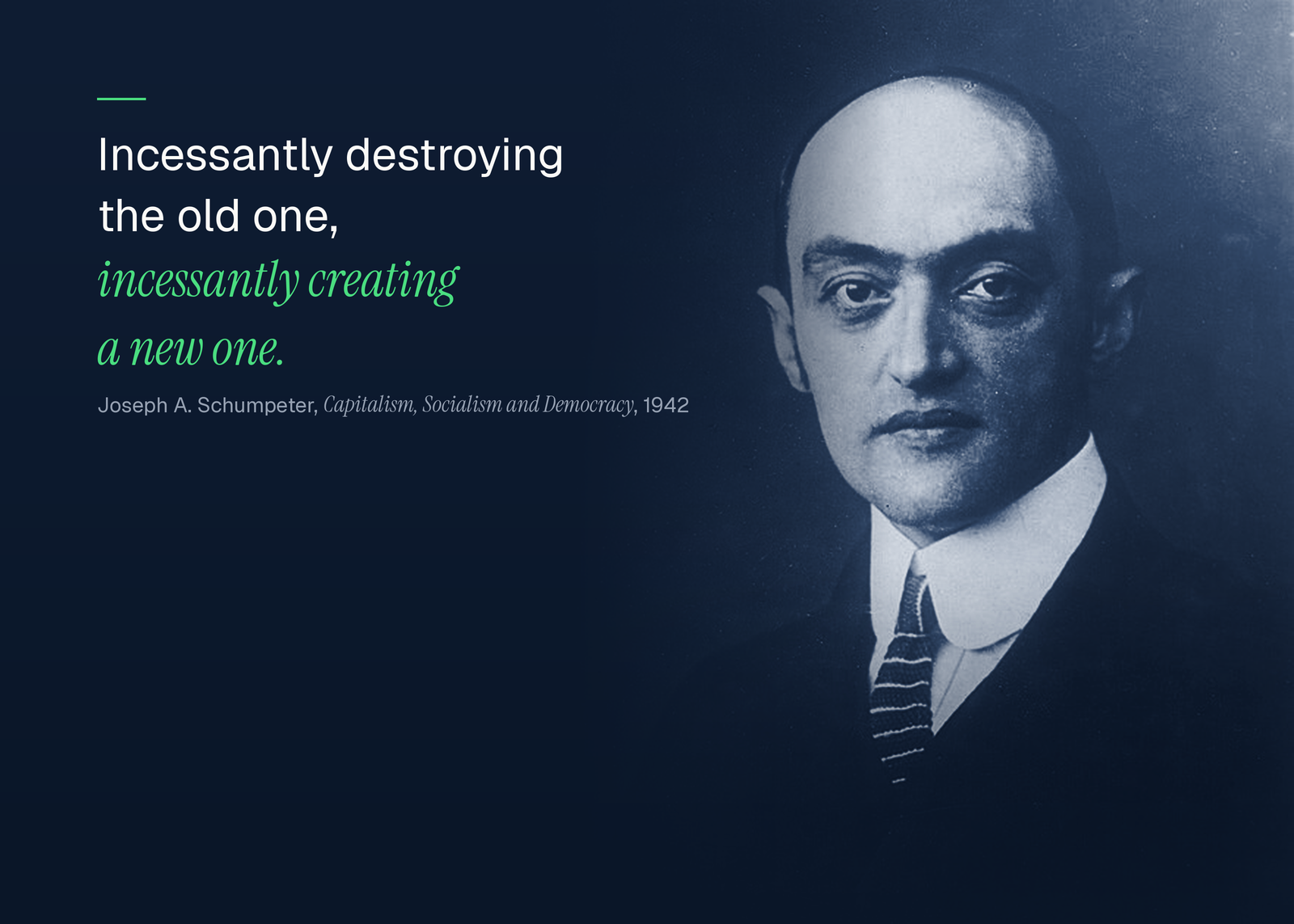
The economic case for the term is older than the consulting industry. Joseph Schumpeter argued in Capitalism, Socialism and Democracy (1942) that market economies renew themselves through creative destruction, the process by which new structures displace old ones and release the resources that finance the next stage of productivity. A restructuring applies that logic inside a single company. Structures get dismantled so that capital, attention and people can move to more productive use. The dividend is the firm-level share of Schumpeter’s renewal, and it arrives only when the creative half of the phrase receives the same weight as the destructive one.
Treat it as an investment, with everything that implies
The obvious objection deserves a straight answer. Every investment can fail. Planning replaces chance with error, and error is the entrepreneur’s daily companion. If restructuring is an investment, the dividend is its expected return, and the failure rate is the risk premium to be priced in.
Genuine risk scatters in both directions, though. A well-calibrated business case would occasionally surprise on the upside. It rarely does. Daniel Kahneman and Dan Lovallo named the pattern the planning fallacy in “Delusions of Success” (Harvard Business Review, 2003), and Flyvbjerg’s project data confirms it at scale: costs come in above the estimate, benefits below it, with remarkable consistency, and the bias points one way. A pattern this stable points to the model.
Scrutiny ends at approval
The bias survives because of what happens after the decision. For many programmes, the approval meeting is the last occasion on which anyone examines the numbers seriously. Attention moves to the next topic, and the programme continues in the shadows.
Politics inside the organisation reinforces the pattern. The sponsor has little appetite for a measurement that could prove him wrong. The approver shares the exposure, since a failed programme reflects on both. A quiet coalition of looking away forms. Barry Staw named the result escalation of commitment in 1976: good money follows bad, because stopping would concede that the approval was a mistake. Sunk costs get booked, emotionally, as investment.
Under these incentives the business case changes its function. It gets written to win approval, the people who grant it know as much, and everyone discounts accordingly. The negotiation begins where the planning was supposed to stand.
The negotiation begins where the planning was supposed to stand.
Three levers turn hope into a claim
Benefits realisation management is the established remedy. It rarely gets implemented cleanly, because it is politically uncomfortable. Three elements decide the outcome.
The first is a set of stage gates with a genuine stopping option. Traffic-light reports kept diplomatically on amber achieve little. A gate earns the name when the programme can die there, and a business case is complete only when it states the point at which the investment counts as failed.
The second is the separation of delivery and measurement. The controlling function measures the benefits, independently of the programme lead who delivers them. Bond issuers write persuasive prospectuses, which is why rating agencies exist.
The third is anchoring the dividend in the line, and it is the strongest of the three. The promised savings get deducted from the receiving unit’s budget in advance. The dividend then becomes a debt to be collected, and the political interest flips. The unit head suddenly has every reason to make the restructuring deliver.
A fourth element belongs in the planning itself. Reference class forecasting benchmarks the case against the actual outcomes of comparable programmes, rather than building it bottom-up from optimism. Missed dividends remain acceptable as long as the forecasts stay calibrated. Whoever misses by 40 per cent three times in a row has a model problem, and at that point the shortfall reveals a governance gap presented as entrepreneurial risk.
Where the term earns its keep
Hard restructurings live this discipline already. Provisions, social plans, run-rate savings and payback periods force the numbers into the open. The value of the term lies in extending the same discipline to the soft programmes: reorganisations, operating-model rebuilds, agile and culture transformations. The failure rates quoted at the start originate largely there.
The restructuring dividend, taken seriously, asks the questions every capital request answers as a matter of course. What is the stake? What is the expected return? Over which period does it arrive? At what point does the investment count as failed?
Strategy is a decision. Execution is a habit. A dividend nobody claims stays unpaid.
Further reading
- Joseph A. Schumpeter, Capitalism, Socialism and Democracy, Harper & Brothers, 1942. The origin of creative destruction, chapter VII.
- McKinsey & Company, “Losing from Day One: Why Even Successful Transformations Fall Short”, McKinsey Global Survey, December 2021.
- Bent Flyvbjerg and Dan Gardner, How Big Things Get Done, Random House, 2023. The 16,000-project database and reference class forecasting.
- Dan Lovallo and Daniel Kahneman, “Delusions of Success: How Optimism Undermines Executives’ Decisions”, Harvard Business Review, July 2003.
- Barry M. Staw, “Knee-deep in the Big Muddy: A Study of Escalating Commitment to a Chosen Course of Action”, Organizational Behavior and Human Performance, 1976.