

Part of the series Leading Through Turbulence.
Why should a leader spend scarce hours on planning methods for futures that may never arrive?
The question deserves an honest answer, because the hours are real and a method can look academic. A managing director has a quarter to close, a board to brief, and a team that wants decisions today. Time given to frameworks and scenarios that never pay off looks, from the outside, like time lost.
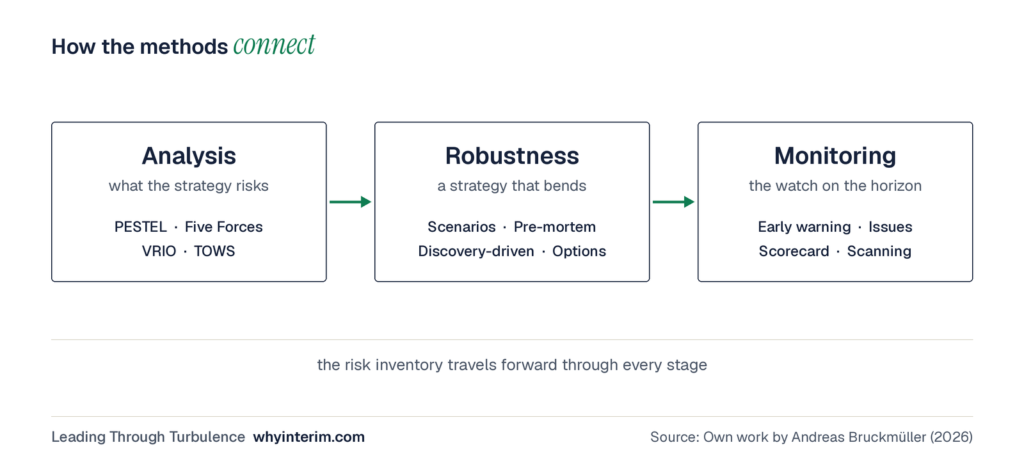
A captain faces the same doubt before leaving harbour. The chart and the barometer are instruments, and reading them takes training and time the weather may never reward. An experienced skipper reads them anyway, because a voyage is planned around where the ship must arrive and what it might meet on the way. The planning methods in this article are those instruments. Some show a leader which risks a strategy takes on. Some help build a strategy able to bend. Some keep watch for a crisis while it is still a smudge on the horizon. Each section answers a part of the opening question, and the closing gathers those parts again.
Seeing what a strategy takes on
Every strategy is a wager. A company commits capital, people, and time to one reading of the future, and in doing so it accepts a set of risks it may not have named. The first task of planning is to name them.
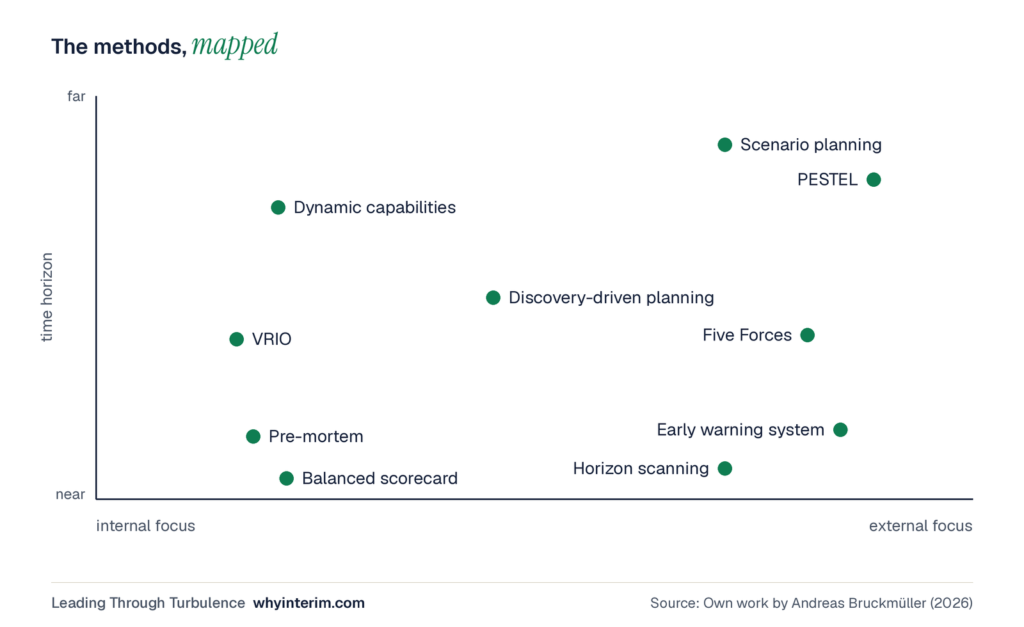
Francis Aguilar gave managers the earliest tool for this in 1967. His book Scanning the Business Environment set out a way to study the outside forces a business cannot control, and his original four categories grew over time into what most boards now call PESTEL: political, economic, social, technological, environmental, and legal. Read properly, PESTEL becomes a set of questions about exposure. Each factor asks what could shift beyond the company’s control and undo the plan, and how much of the strategy depends on it staying unchanged. The strongest use ranks the factors, weighing each by likely impact and likelihood, and ties each to a specific decision the company has already made.
Where PESTEL scans the wider weather, Michael Porter’s five forces read the immediate waters of an industry. In a 1979 article that has shaped strategy teaching ever since, Porter set out five structural pressures: the rivalry among existing firms, the threat of new entrants, the threat of substitutes, the bargaining power of suppliers, and the bargaining power of buyers. Each force marks a risk the strategy has accepted. A business that leans on a handful of suppliers is exposed to supply risk. A market with low barriers to entry opens the door to sudden new competition. Naming the force names the exposure.
The outward view needs an inward complement. Jay Barney’s resource-based view, set out in 1991, asks which of a firm’s advantages are genuinely durable. The VRIO test runs each supposed strength through four questions: whether it is valuable, whether it is rare, whether it is hard to imitate, and whether the organisation is built to exploit it. A strength that fails the test is a hidden risk, an advantage that looks solid until the first serious challenge wears it away.
These three readings meet in a familiar frame. SWOT gathers strengths, weaknesses, opportunities, and threats onto a single page, and its honest limitation is that the page often stays a static list. Heinz Weihrich answered that in 1982 with the TOWS matrix, which crosses the factors and turns them into moves: how a given strength can blunt a specific threat, or how an opportunity can cover a weakness. The bookkeeping becomes a decision.
What this means for you
- Hold your current strategy against the six PESTEL factors and the five forces.
- Write down the three exposures that would hurt most if they moved against you.
- Let those three set the agenda that the rest of your planning has to answer for.
Building a strategy that bends
Naming a risk does not disarm it. Once a leader knows which exposures the strategy runs, the next task is to build a strategy that can take a blow and stay afloat.
Pierre Wack made the case for this more vividly than anyone. Working as a planner in the early 1970s, Wack grew impatient with forecasts that offered a single confident line into the future. He built instead a discipline of scenarios, several coherent stories of how the world might unfold, and he pressed decision-makers to rehearse their choices against each one. When the oil price broke sharply in 1973, the managers he had trained kept their heads, because they had already imagined a world in which it happened. Wack’s lesson was that a scenario earns its keep through preparation, by making an unfamiliar future familiar before it arrives.
Rita McGrath and Ian MacMillan added a second discipline in 1995. Their discovery-driven planning starts from a hard admission: in a genuinely uncertain venture, most of the plan is assumption rather than fact. So they treat each assumption as a hypothesis to be tested, they rank those hypotheses by how much rests on them and how little is known, and they release money in stages as each one is proven. Funding follows evidence. A plan built this way shows its flaws at a checkpoint, while the cost of stopping is still small.
Gary Klein offered a smaller tool that costs nothing and asks only for honesty. Before a big commitment, the team imagines that the plan has already failed a year on, and works backwards to explain why. The exercise, which Klein calls a pre-mortem, gives quiet doubts a licence to speak, the doubts that a confident planning meeting usually buries. It sharpens the decision before the decision is made.
Underneath these methods sits a single principle: keep your options open where the future is dark. David Teece and colleagues named the deeper capacity in 1997, calling it dynamic capabilities, the firm’s ability to sense change, seize the opportunities it brings, and reshape itself in time. In planning terms that means favouring moves that can be reversed, staging commitments, and keeping a reserve, so that no single wrong bet breaks the company. A strategy built for one future is brittle. A strategy that keeps a few doors open can bend.
What this means for you
- Run a pre-mortem before your next major commitment, assuming the plan has already failed a year on.
- Name the three assumptions the strategy cannot survive without.
- Decide now how you would know early if one of them began to give way.
Keeping watch on the horizon
A plan and a robust strategy still leave one gap open. The exposures named in analysis do not stay fixed, and the future the scenarios imagined keeps changing shape. Something has to watch the horizon while the ship sails, and turn a faint signal into a warning in time to act.
The idea has a clear origin. In 1975 Igor Ansoff argued that strategic surprises rarely arrive without notice, and that the notice comes first as what he called weak signals, faint and ambiguous hints of a discontinuity to come. An earlier article in this series looked at how a leader learns to perceive such signals. The task here is a different one, to build the apparatus that does the perceiving as a matter of routine. That apparatus is the strategic early warning system, and its logic is a steady loop. It scans the environment for weak signals, it diagnoses the few that matter by studying them in context, and it feeds a considered response back into strategy. The system runs continuously, as a standing part of how the company is led.
Ansoff supplied the organisational half five years later. His strategic issue management describes how a firm catches an emerging issue, ranks it by urgency, and assigns someone to act, so that a signal picked up by scanning does not die in an inbox. The scanning finds the issue. The issue management decides what happens next.
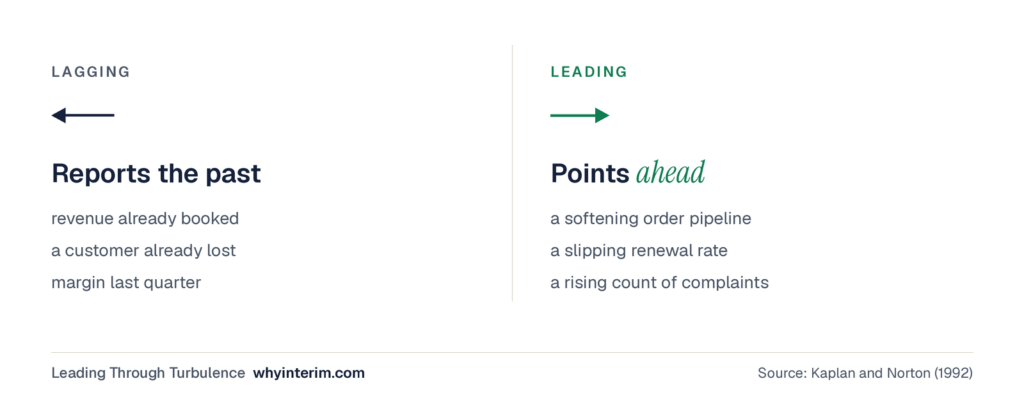
Not every warning comes from outside. Robert Kaplan and David Norton built an instrument for the inside view, the balanced scorecard, and its most useful contribution to early warning is the distinction between lagging and leading indicators. A lagging indicator reports what has already happened, last quarter’s revenue, a customer already lost. A leading indicator points ahead, a softening order pipeline, a slipping renewal rate, a rising count of complaints. A scorecard weighted towards leading indicators turns the company’s own numbers into a radar.
Two further ideas complete the picture. George Day and Paul Schoemaker studied why capable companies still miss what is coming, and located the failure at the edges of attention, in a shortage of what they call peripheral vision. The signals that matter most often appear where a firm is not looking. Horizon scanning answers that by making the looking deliberate, naming a handful of domains to watch, from technology to regulation, assigning each to an owner, and pooling what they find in one shared place rather than scattered notebooks.
A signal that no one is assigned to notice is a signal the business has quietly chosen to ignore.
What this means for you
- Choose the few leading indicators that would move first if your biggest exposure began to turn.
- Give each one an owner and a fixed monthly moment when someone looks at it.
- Treat a number no one is scheduled to read as a number working for no one.
Why the law asks for it in any case
For a large part of the economy, this is settled by law. The methods a leader might weigh on their merits are, for many companies, a documented duty and a condition of doing business.
The pattern was written in disaster. In 1976 a chemical plant near Seveso, north of Milan, released a cloud of dioxin over the surrounding towns, poisoning land and people and forcing thousands from their homes. Europe’s answer was a family of laws, the Seveso Directives, that require operators handling dangerous substances to assess their hazards, run a safety management system, and prove their preparedness to the authorities. Regulation, here as so often, learned from the wreckage.
The same instinct runs through company law. In Germany, section 91 of the Stock Corporation Act, introduced by the KonTraG reform in 1998, obliges the management board to put in place a monitoring system so that developments threatening the company’s survival are recognised early. The duty reaches beyond listed firms, since the legislature made clear it radiates to other legal forms. In Austria the pattern repeats through the internal control obligations of the GmbH and stock corporation acts, and through the requirement that the management report set out the material risks a company faces. Across the European Union, the Corporate Sustainability Reporting Directive now compels a formal assessment of which environmental and social matters are material to the business, which is environmental scanning made into statute.
One point runs through all of it. Section 91 has been read by the courts to require that the early-warning system be written down, and auditors test whether it actually works. The obligation is a continuing watch, renewed each period, evidenced and open to audit. A risk assessment performed once and filed away satisfies none of that.
The specific duties vary by sector. Consider the five industries set out below, where this practice most often earns its place. Each one is bound by at least one regulatory regime. In energy, treated as critical infrastructure, the European Union’s directives on critical entities and on network security require operators to run their own risk assessments and to build resilience into the business, and they place that responsibility with the board. In technology, the Artificial Intelligence Act obliges providers of high-risk systems to maintain a risk management process across the whole life of the system, established, documented, and kept current, so that a single filed assessment will not do. In industry, the Seveso regime and the newer supply-chain due-diligence laws require a firm to look for hazards inside the plant and for human-rights and environmental risks along the whole chain of supply. In retail and consumer markets, and sharply in gaming, anti-money-laundering law compels operators to assess their exposure, verify their customers, and report what they find, and the industry has come to treat that discipline as the thing that protects the licence. In operations, the international standards for risk management and business continuity have no criminal force, yet clients write them into contracts often enough that they bind in practice.
The reach does not stop at regulators. The same analyses are what lenders and investors ask to see. A bank tightening its watch on a borrower will want a forward view of cash and risk, and a company that can produce one keeps options a weaker-governed rival loses. Rating agencies weigh the quality of a firm’s risk management. Prospectus rules and governance codes expect a working system before capital is raised or a board is trusted. For an owner, command of these methods widens access to capital, and neglect of them narrows it.
Where this crosses into the formal machinery of a risk register, with scored risks and named owners, it becomes a subject of its own, and a later article in this series takes up risk management in full.
What this means for you
- Find out which of these duties already bind your company, by legal form, by sector, and by your financing covenants.
- Check whether your early-warning system is written down and genuinely in use.
- Assume an auditor or a lender could ask to see it tomorrow, and be ready to show it.
What a smaller company should still do
None of this needs a large company to be worth doing. The argument is sometimes made that scanning, scenarios, and early-warning systems are luxuries for firms with staff to spare. The truth runs the other way. Foresight is most valuable to the company that can least afford a surprise, and a smaller firm has one real advantage over a large one, in that it can turn quickly once it has seen.
So the methods scale down without losing their point. A half-day each year, spent walking a small team through PESTEL and the five forces, produces a usable map of exposure on a single page. A short register of the five to ten risks that matter most, each ranked by likelihood and impact and each given an owner, does the work of a corporate risk function at a fraction of the weight. A handful of leading indicators, watched at a fixed moment every month, stands in for a full early-warning system. The thirteen-week view of cash, which larger firms reach for only in trouble, is the single most protective instrument a small business can keep, because it turns the fear of running out into something a leader can steer. The pre-mortem, costing nothing but candour, guards the big decisions.
The principle is simple. Match the effort to the size of the decision, and keep the tools light enough that a small team will actually use them. A rough judgement written down and revisited protects a small company more surely than an elaborate model it has no time to feed.
What this means for you
- Name the single risk most likely to end your business.
- Choose the one indicator that would show it turning, and look at it every week from now.
- Keep one number watched faithfully rather than a binder no one opens.
Why the hours are worth it
So, why should a leader spend scarce hours on planning methods for futures that may never arrive?
A leader does it to see which risks the strategy has taken on, because a wager named is a wager that can be managed. A leader does it to build a strategy that bends instead of breaking, so that a single wrong forecast does not sink the enterprise. A leader does it to keep a watch on the horizon, so that a crisis is met while it is still small. A leader does it because, for much of the economy, the law and the capital markets now require the watch to be kept, and kept visibly. And a leader does it because even the smallest company gains more from a little foresight than from none.
The captain’s chart and lookout do not still the storm. They decide whether the storm arrives as a surprise or as something the ship was ready to meet.
When the weather turns, a prepared leader has already seen the turning, thought it through, and made the ship ready to meet it.
Reading the weather is the work of planning. Handling the storm once it breaks is a craft of its own, which a later article in this series takes up.
Further reading
Analysis and strategy
- Francis J. Aguilar: Scanning the Business Environment, Macmillan (1967)
- Michael E. Porter: How Competitive Forces Shape Strategy, Harvard Business Review (1979)
- Jay B. Barney: Firm Resources and Sustained Competitive Advantage, Journal of Management (1991)
- Heinz Weihrich: The TOWS Matrix: A Tool for Situational Analysis, Long Range Planning (1982)
Planning under uncertainty
- Pierre Wack: Scenarios: Uncharted Waters Ahead, Harvard Business Review (1985)
- Rita Gunther McGrath & Ian C. MacMillan: Discovery-Driven Planning, Harvard Business Review (1995)
- Gary Klein: Performing a Project Premortem, Harvard Business Review (2007)
- David J. Teece, Gary Pisano & Amy Shuen: Dynamic Capabilities and Strategic Management, Strategic Management Journal (1997)
Early warning and monitoring
- H. Igor Ansoff: Managing Strategic Surprise by Response to Weak Signals, California Management Review (1975)
- H. Igor Ansoff: Strategic Issue Management, Strategic Management Journal (1980)
- Robert S. Kaplan & David P. Norton: The Balanced Scorecard: Measures That Drive Performance, Harvard Business Review (1992)
- George S. Day & Paul J. H. Schoemaker: Scanning the Periphery, Harvard Business Review (2005)
Regulation and standards
- Aktiengesetz, Section 91: early recognition of risks, Germany
- European Union, Artificial Intelligence Act, Article 9: risk management system (2024)
- European Commission, Industrial accidents and the Seveso Directive
- European Commission, Critical Entities Resilience and NIS2 Directives (2024)
- European Union, Corporate Sustainability Reporting Directive 2022/2464 (2022)
- European Union, Corporate Sustainability Due Diligence Directive 2024/1760 (2024)
- International Organization for Standardization, ISO 31000 Risk Management and ISO 22301 Business Continuity Management