

Four principles for leaders who cannot afford to wait for calmer times
Part of the series Leading Through Turbulence.
History moves in a spiral. Not in circles. The same challenges do not repeat identically, but forward, with recurring patterns of stability and turbulence at each new turn. Periods where planning is straightforward and the future is roughly foreseeable. And periods where last year’s strategy becomes this year’s liability, and the ability to act without complete information matters more than any forecast.
Turbulent times always return. When they do, the leadership challenge is the same: calm-weather thinking fails in a storm. Leading in a crisis requires a different approach: decisiveness over optimization, resilience over efficiency, action over analysis. Knowing which mode you are in, and leading accordingly, is the first discipline.
Peter Drucker understood this decades ago. Writing in Managing in Turbulent Times (1980), he argued that turbulence demands a specific response from leadership: not more analysis, but clearer decisions. Not better forecasts, but stronger organizational resilience. His words have not aged. They have sharpened.
The companies that thrive in periods like this are not the ones with the most elegant strategy decks. They are the ones with leaders who can be decisive, inspire their teams, get shit done, and stay positive while doing it.
Here’s what that actually looks like.
The Reality Check: What Leaders Are Up Against
The numbers are unambiguous. Geopolitical and political uncertainties have topped the list of CEO concerns for several years running. Trade policy, shifting alliances, regulatory fragmentation, AI competition between superpowers. These are no longer theoretical risks. They land on strategy tables every Monday morning.
Hugh Courtney, Jane Kirkland, and Patrick Viguerie identified this problem precisely in their landmark Harvard Business Review article “Strategy Under Uncertainty” (1997), still the most rigorous framework for thinking about this challenge. Their core insight: executives tend to make one of two fatal errors. They either underestimate uncertainty, forcing false precision into their forecasts, or they overestimate it, abandoning analysis entirely and going with gut instinct. Neither works.
The answer, they argued, is a disciplined portfolio of strategic moves: big bets for high-conviction positions, optionsthat preserve flexibility, and no-regrets moves that pay off regardless of how uncertainty resolves.
This is not a new problem. It is a permanent one. And the leaders who handle it best have always known something that anxious managers forget: uncertainty is not the enemy of strategy. Paralysis is.
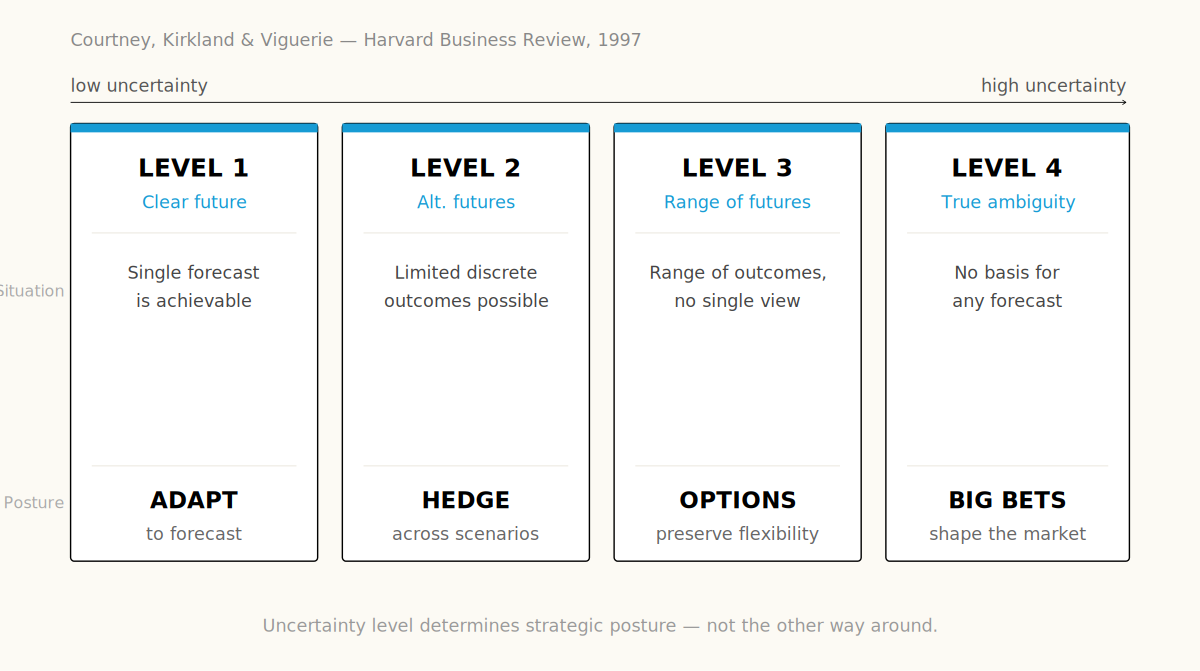
Fig. 1: Four Levels of Uncertainty. Courtney, Kirkland & Viguerie, HBR 1997
1. Be Decisive: Strategy Is a Choice, Not a Committee
In uncertain environments, the temptation is to keep all options open. To wait for more data, to build one more scenario. This feels prudent. It isn’t.
Roger Martin and A.G. Lafley put it plainly in Playing to Win (HBR Press, 2013): strategy is hard not because it is complex, but because it forces people and organizations to make specific choices about their future. Something few companies actually do. The moment you choose where to play and how to win, you are also choosing what not to do. That takes courage.
Victor Vroom and Philip Yetton, in their seminal work Leadership and Decision-Making (1973), add an important nuance: being decisive does not mean always deciding alone. Their research showed that the right decision-making method depends on the situation. Sometimes speed and clarity demand an autocratic call. Sometimes the quality of the decision requires bringing others in. What matters is choosing the appropriate method deliberately and executing it with conviction. Indecision is never the right method.
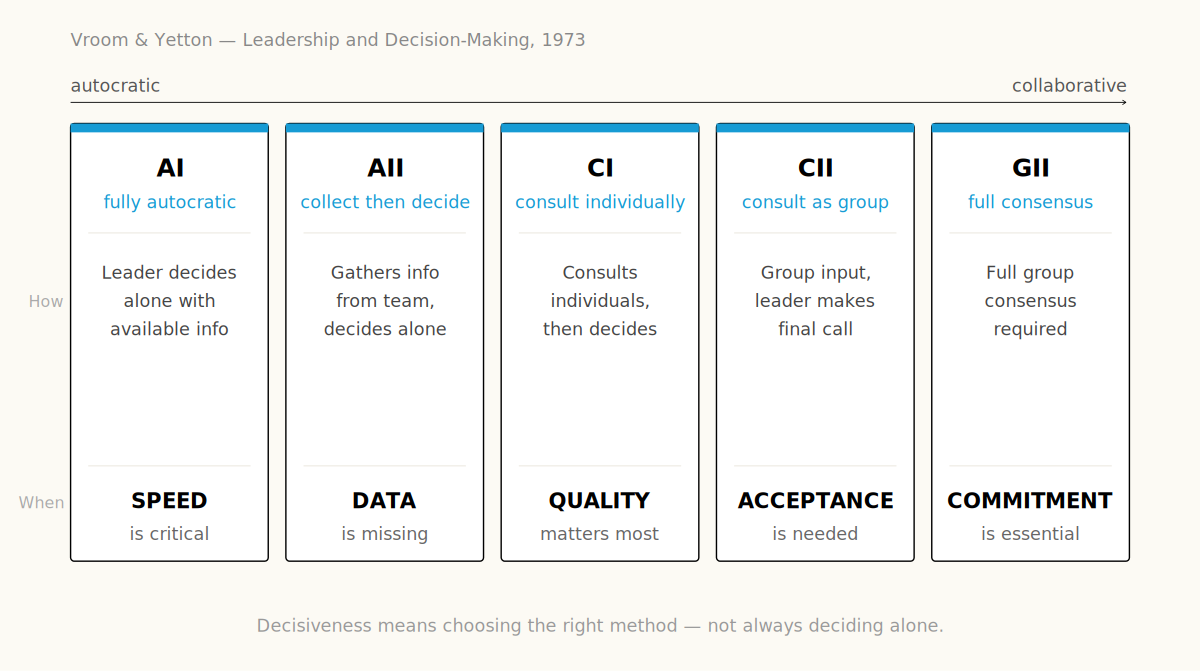 Fig. 2: Five Decision-Making Styles. Vroom & Yetton, 1973
Rita McGrath, in The End of Competitive Advantage (2013), goes further. In a world of transient advantage, the companies that win are not those with the best single strategy. They are those with the capability to reconfigure rapidly, wave after wave. Strategy is not a destination. It is a muscle.
The Churchill Lesson
Winston Churchill understood the cost of indecision better than almost any leader in history. When he became Prime Minister in May 1940, Britain stood almost entirely alone. France had collapsed. The United States had not yet entered the war. His military advisers were divided. His Cabinet debated negotiated peace.
Churchill did not convene another committee. He chose. He committed. He communicated. Not with false optimism, but with radical clarity about what was at stake and what would be done about it.
His approach to strategy combined vision with operational pragmatism, strategic courage with tactical flexibility. He understood that in a crisis, the absence of a decision is itself a decision. Usually the worst one.
What this looks like in practice today:
- Shorten strategic planning cycles from annual to quarterly
- Define explicit “trigger points” that prompt strategic pivots
- Separate the decision from the analysis. More data is not always the answer
- Treat strategy as a portfolio of bets, not a single plan
2. Inspire Others: Make the Crisis the Rallying Point
People don’t follow spreadsheets. They follow conviction.
Inspiring others is not about motivation techniques or creating the right atmosphere. In turbulent times, it is about something more fundamental: being the calm in the room when everyone else is losing their bearings. The leader who can name the reality clearly, hold a direction with genuine conviction, and make others believe that the organization is equal to what it faces. Not because the future is certain, but because the direction is.
This is different from building a debating club. In a crisis, the time for open-ended exploration has limits. What people need is not a leader who facilitates all perspectives equally. They need someone who has processed the uncertainty, drawn a clear line, and can communicate it in a way that others want to follow. Clarity itself is a form of leadership. So is the ability to give others a reason to move that goes beyond self-interest.
The Churchill Lesson at a Different Level
Churchill understood this distinction precisely. His famous speeches were not invitations to debate. They were acts of direction-setting under extreme pressure. When he told the British people in 1940 that Britain would fight on the beaches, in the fields, in the streets, he was not presenting options. He was creating a shared reality that people could attach themselves to.
What made it work was not rhetoric alone. It was the combination of brutal honesty about the situation and absolute clarity about the direction. He did not shield his audience from how serious things were. He named it fully, and then gave them something to stand behind. That combination, transparency about the facts and conviction about the path, is what turns anxiety into momentum.
The business application is direct: radical transparency about the challenge, combined with unwavering clarity about the mission, is what turns anxiety into momentum. Don’t shield your team from the reality of what you’re navigating. Name it. Then give them a direction worth following.
What this looks like in practice today:
- Name the situation directly. People sense when leaders are managing the message.
- Communicate the direction with conviction, not with caveats
- Frame external uncertainty as shared mission, not shared threat
- Be the calm reference point others can orient themselves around
3. Get Shit Done: Execution Is the Strategy
Here’s the uncomfortable truth most strategy frameworks won’t tell you: most organizations don’t fail because of bad strategy. They fail because of no execution.
Drucker was blunt about this in The Effective Executive (1966): effectiveness is not about being smart. It is about doing the right things, and doing them. Strategy without implementation is just expensive storytelling.
Fredmund Malik, the Austrian management thinker and author of Führen, Leisten, Leben (2000), sharpens this further. Malik draws a hard line between activity and effectiveness. Busy organizations are not necessarily effective ones. In turbulent times, this distinction becomes critical. Leaders who confuse motion with progress burn resources on the wrong things at exactly the wrong moment. Malik also rejects the myth of the exceptional leader born with rare gifts. Management, he argues, is a learnable craft with clear principles, tasks, and tools. Decisiveness under time pressure is not a personality trait. It is a discipline that can be developed and practiced.
Nassim Nicholas Taleb adds a sharper edge in Antifragile (2012). The opposite of fragile is not robust. It is antifragile. Antifragile systems don’t just survive shocks. They get stronger because of them. The organizations that execute through turbulence are not just managing risk. They are building capabilities that fragile competitors cannot match.
Taleb’s prescription for antifragility in practice: keep fixed obligations low, maintain optionality, and make small bets with asymmetric upside. Don’t optimize for the average case. Prepare for the tails.
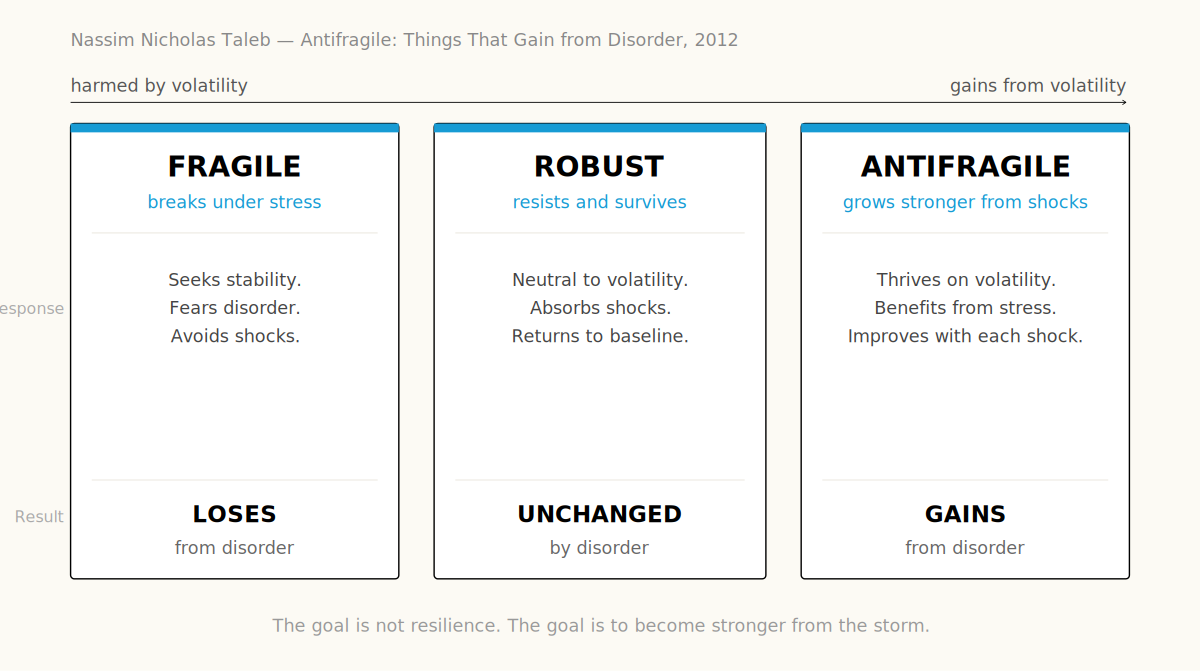 Fig. 3: Fragile, Robust, Antifragile. Nassim Nicholas Taleb, 2012
The Marcus Aurelius Lesson
The Roman Emperor Marcus Aurelius led through some of the most catastrophic crises in Roman history: floods, famines, invasions, and the Antonine Plague, which killed up to 2,000 Romans per day for years. He recorded his leadership principles in what we now know as Meditations.
His core operational discipline: act, don’t ruminate. He wrote to himself constantly about the gap between thinking and doing, and the danger of mistaking one for the other. He did not wait for certainty before making decisions. He acted on the best available information, reviewed results honestly, and corrected course.
Nineteen centuries before modern agile methodology, Marcus Aurelius was running iterative leadership cycles under extreme uncertainty.
What this looks like in practice today:
- Every strategic decision needs an owner and a deadline. Immediately.
- Build 30-60-90 day implementation rhythms, not annual roadmaps
- Reward fast learning from failure as much as success
- Measure execution velocity, not just strategic quality
4. Stay Positive: Resilience Is a Strategic Asset
Positivity in crisis is not denial. It is the engine of resilience. And resilience, in Taleb’s framework, is only the beginning.
Nancy Koehn, Harvard Business School historian and author of Forged in Crisis (2017), studied five leaders who built something extraordinary from the wreckage of apparent failure: Lincoln, Frederick Douglass, Ernest Shackleton, Dietrich Bonhoeffer, and Rachel Carson. Her finding: leaders are not born in comfortable times. They are forged in hard ones.
Shackleton’s story is the most visceral example. His 1914 Antarctic expedition failed by every conventional metric. He never reached the Pole, his ship was crushed by pack ice, and his crew was stranded on one of the most remote places on Earth for nearly two years. He brought every single man home alive. His leadership secret? He refused to let his team define the situation as defeat. He reframed it continuously as a problem to be solved, a challenge to be met, a story worth telling.
This is exactly what staying positive means for business leaders in turbulent times. Not toxic optimism. Not ignoring the severity of challenges. But the relentless insistence that there is a path forward. That the organization is capable of finding it.
Peter Drucker called this “exploiting successes,” one of his four core strategies for managing in turbulent times. Don’t pour resources into defending what’s failing. Concentrate energy on what’s working and build from there.
What this looks like in practice today:
- Audit your portfolio: where is momentum already building? Invest there.
- Separate “tough but winnable” from “structurally broken” and be honest
- Build psychological safety so problems surface early, not late
- Model composure. Fear is contagious, and so is confidence
The Through-Line: What History’s Best Leaders Knew
Churchill, Lincoln, and Marcus Aurelius lived in different centuries, faced different crises, and led very different organizations. But they shared one thing that no management framework captures cleanly: they did not wait for the storm to pass before leading. They led because of it, and through it.
That is what turbulent times actually demand. Not better planning tools. Not another scenario workshop. Four things, practiced daily: the decisiveness to choose when choosing is hard, the clarity to give others something worth following, the discipline to execute when everything pulls toward delay, and the composure to stay positive when the situation argues otherwise.
These are not personality traits. They are disciplines. And like all disciplines, they are built before they are needed.
The question is not whether turbulence is coming. It is whether you are to lead when it arrives.
One question worth sitting with:
When did you last make a decision that was uncomfortable, that required real courage, and that moved your organization forward? Not a committee conclusion. Not a deferred judgment. A decision.
If you have to think hard to remember, that is worth paying attention to.
Further Reading
Strategy & Management
- Peter F. Drucker: Managing in Turbulent Times (1980)
- Peter F. Drucker: The Effective Executive (1966)
- Fredmund Malik: Führen, Leisten, Leben (2000)
- Nassim Nicholas Taleb: Antifragile: Things That Gain from Disorder (2012)
- Rita McGrath: The End of Competitive Advantage (2013)
- Rita McGrath: Seeing Around Corners (2019)
- Roger Martin & A.G. Lafley: Playing to Win (2013)
- Victor Vroom & Philip Yetton: Leadership and Decision-Making (1973)
- Hugh Courtney: 20/20 Foresight: Crafting Strategy in an Uncertain World (2001)
Academic Articles
- Courtney, Kirkland & Viguerie: “Strategy Under Uncertainty”, Harvard Business Review (1997)
- Bennett & Lemoine: “What VUCA Really Means for You”, Harvard Business Review (2014)
Historical Leadership
- Nancy Koehn: Forged in Crisis: The Power of Courageous Leadership in Turbulent Times (2017)
- Doris Kearns Goodwin: Leadership in Turbulent Times (2018)
- Marcus Aurelius: Meditations (approx. 161–180 AD)
- John Kotter: Accelerate: Building Strategic Agility for a Faster-Moving World (2014)