
Third letter from Michael to Andreas
My dear Andreas,
The words of your letter strike a raw nerve. Not because they are dramatic but precisely because they are measured. And sobriety, in an age of collective comfort, is itself a provocation.
We have grown accustomed to critical infrastructure, digital tools, and entire value chains simply working. Yet what we call functionality has long since become vulnerability.
Our primary dependence on the United States is no theoretical construct. It is concrete, daily, and structural:
We entrust our data to platforms governed by foreign law. We build our enterprises on clouds whose terms may be altered at another’s pleasure. We embed AI models, APIs, and security services whose course we do not set. We accept export controls, sanctions regimes, and extraterritorial statutes as footnotes though in a moment of crisis, they will decide whether we can act at all.
These are not abstract risks. This is the real condition.
A shift in Washington, a new sanctions package, a geopolitical rupture with China — and European enterprises could find themselves without tools, administrations without systems, critical processes without support.
To put it plainly: the United States has always acted strategically. That is legitimate. What is dangerous is that we do not.
He who relies on another’s resilience has surrendered his own.
The legal situation weighs upon us with particular gravity. The CLOUD Act, FISA, national security interests — these mean that European data, processes, and trade secrets ultimately remain conditional. We may operate servers in Vienna or Frankfurt. The authority to decide still sits outside Europe. It is not the location of the server that determines sovereignty. It is jurisdiction. Ownership. Strategic control over key technologies.
Europe has maneuvered itself into a paradox: economically strong, technologically dependent, and politically fragmented.
The creeping tendency toward petty nationalism sharpens this dilemma. Each nation optimizes for itself. Each wishes to negotiate alone. Each builds its own small solution. This does not produce a counterweight to the great powers it produces a fragmented region that can offer little resistance to either of the two dominant blocs.
Sovereignty is not the sum of national islands. It is a collective undertaking.
If Europe does not invest together in its own cloud infrastructure, its own AI models, its own security architectures, its own open-source ecosystems, we will remain perpetual consumers of others’ decisions. We will regulate what we can no longer shape. We will write directives for technologies we do not command.
Does Europe wish only to administer its own decline?
You name open source as a glimmer of hope. I agree. But here too: openness without competence is illusion. He who only consumes open code without maintaining, funding, auditing, and strategically embedding it, merely trades a proprietary dependence for an informal one.
Europe needs not only open software. Europe needs its own maintainers, its own roadmaps, its own operating models. Above all, it needs the political will to regard these things as strategic infrastructure, not as the hobby of idealists.
And for precisely this reason, we must cease retreating into national vanities. In this contest, no small state survives alone. Only alliances carry weight. Only common standards create market power. Only coordinated investment produces resilience.
The Stoics knew: one need not control all things, but one must know which things one does not control.
The sovereign man is not he who masters everything, but he who stands firm where his control ends.
By now, we ought to know this. The question is only whether we and our political leaders possess the courage to draw the consequences at last.
For freedom, dear Andreas, does not consist in the ability to choose between vendors.
It consists in still being able to choose at all.
In this sense, our dialogue is no mere intellectual exercise. Let it be a small contribution to the recovery of European judgment.
And perhaps, if we remain steadfast, a beginning.
Let us therefore not linger in the recognition of our condition, but counsel together on what concrete steps Europe must now take. For insight without action is monologue. Only deeds lend weight to understanding.
In fellowship,
Your friend Michael
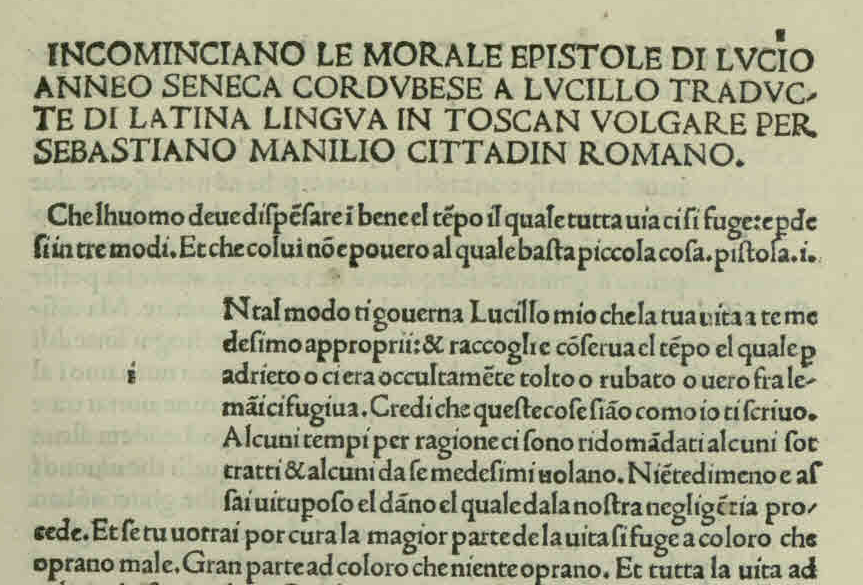
This text is an experiment: a public exchange of letters between Michael Mrak and myself, inspired by Epistulae morales ad Lucilium, in which reflections on sovereignty far beyond the digital context are developed further through dialogue.