
Part of the series Leading Through Turbulence.
How much certainty may a leader wait for before a decision stops being prudent and starts being late?
The case for waiting deserves an honest hearing, because it rests on real virtues. More information usually improves a decision. Diligence is a duty, boards reward analysis, and the graveyard of business holds plenty of bold calls that a week of further study would have prevented. A leader who asks for one more report is rarely criticised in the moment.
A captain at the helm knows the limit of that logic. The previous article in this series was about reading the weather, the charts, scans and early warnings that show what may be coming. At some point the reading is done, the barometer is falling, and the wheel has to be turned while the sky is still arguing with the forecast. Waiting for the storm to declare itself is also a decision, and usually the worst one available. This article is about that moment: how to decide well when the information is incomplete, the clock is honest, and the outcome is uncertain.
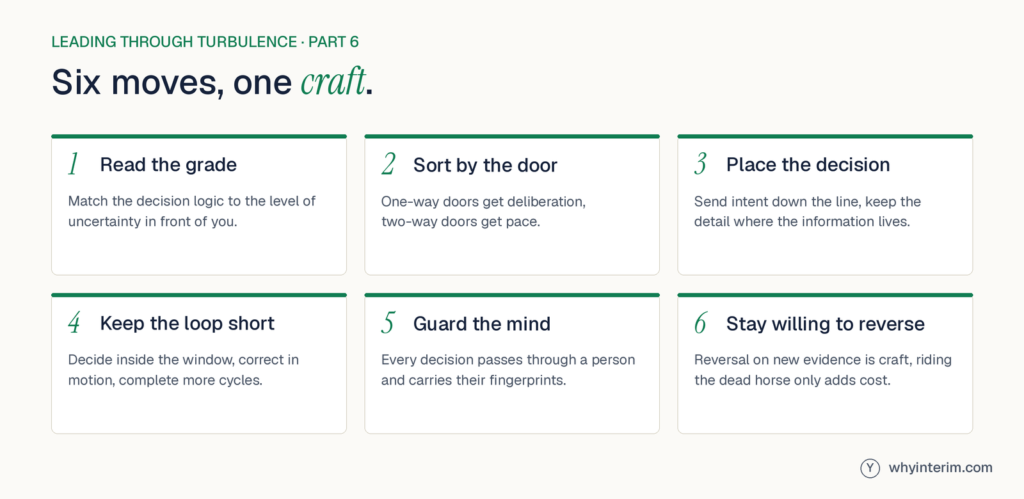
Figure 1. Six moves, one craft. The grade sets the logic, the door sets the pace, the placement sets the decider, the loop sets the tempo, the mind needs guarding, and the willingness to reverse keeps every two-way door real.
Reading the grade of uncertainty
Uncertainty is often treated as a single condition, either present or absent. In practice it comes in grades, and the grade determines which decision logic applies. Hugh Courtney, Jane Kirkland and Patrick Viguerie, whose four levels of uncertainty appeared in the first article of this series, distinguish a clear-enough future, a set of alternate futures, a range of possible outcomes, and true ambiguity.
The consequence for deciding is direct. When the future is clear enough, analysis deserves the lead and the decision should follow it promptly. When a handful of discrete scenarios compete, the decision can be taken now, with defined triggers that say which scenario is arriving and what changes then. When only a range can be described, the sound move is a robust core commitment surrounded by options. In true ambiguity, action itself becomes the instrument of learning, taken in small, survivable steps that buy information.
Most expensive decision failures in turbulent periods trace back to a mismatch here. Leaders apply clear-future logic to ambiguous situations and commit heavily to one reading of the fog. Or they apply ambiguity logic, which in daily life looks like hesitation, to situations that are perfectly analysable, and the market moves while the analysis circles.
What this means for you
- Before a major decision, name the level of uncertainty out loud in the room.
- Match the process to the level, and refuse heavyweight analysis where the future is genuinely dark.
- Name the trigger that would tell you which future is arriving, and put it in writing when the decision is heavy enough to be disputed later.
Sorting by the door
The second sorting question concerns reversibility. Jeff Bezos gave it the most useful modern formulation in his 2015 letter to shareholders: some decisions are one-way doors, consequential and nearly impossible to undo, and these deserve slow, methodical deliberation. Most decisions are two-way doors. Whoever walks through and dislikes the other side can walk back. Bezos observed that growing organisations tend to run the heavyweight one-way process on almost everything, and pay for it in slowness, risk aversion and diminished invention. His remedy in the following year’s letter was equally concrete. Most decisions should be taken with around 70 per cent of the information one wishes for, because course correction makes error cheap, while slowness is reliably expensive.
Each type of door has its exemplar, and both stood in the same century. In October 1962, John F. Kennedy faced photographs of Soviet missile sites in Cuba and immediate pressure from his generals for an air strike. He recognised an irreversible decision when he saw one, and deliberately slowed it down. For thirteen days his executive committee examined options, stress-tested assumptions and argued in his absence so that rank would not silence dissent. The eventual naval quarantine preserved a path backwards for both sides. That is the one-way discipline: deliberation held open for as long as the window allows, against the loudest voices in the room.
The other half of the discipline is knowing when the window closes. On the evening of 4 June 1944, Dwight D. Eisenhower had already postponed the Normandy landings once. A storm had shut the Channel, 150,000 soldiers waited in ships and camps, and the tide window was days from ending. At 21:30 his chief meteorologist, Group Captain James Stagg, reported a probable break in the weather, perhaps thirty-six hours of workable conditions, with no guarantee attached. The commanders debated. Eisenhower gave the provisional order that evening, confirmed it in the early hours with the plainest words available to him, “OK, let’s go”, and then drafted a note accepting sole responsibility in case of failure. The note stayed in his pocket. A one-way door, decided at the last moment the decision still had value, on the best information the moment offered.
My own master’s research suggests where organisations misplace the two types. In a 2022 survey of 66 managers and employees across company sizes, 92 per cent located the relevant management decisions at the top of the organisation. Yet the same respondents named, on average, close to three distinct reasons for delegating decision rights downwards, led by flexibility in the business (56 per cent), company size (47 per cent) and employee motivation (42 per cent). The two findings resolve cleanly along the door metaphor. The few genuinely irreversible, direction-setting decisions belong at the top. Everything reversible belongs where the information lives, and the organisations that struggle are those that never make the distinction explicit, so that every decision queues at the same desk.
What this means for you
- Sort the decisions on your desk into one-way and two-way doors, in writing if the situation calls for it.
- Give the two-way doors a light process and a short deadline.
- Reserve your deliberation, and your best people, for the doors that lock behind you.
Placing the decision where the information is
The oldest systematic answer to deciding under uncertainty comes from nineteenth-century Prussia. Helmuth von Moltke the Elder, chief of the Prussian general staff, wrote in 1871 the sentence that survives in condensed form as “no plan survives contact with the enemy”. His conclusion was radical for a hierarchical institution. Since the centre cannot foresee the situation at the front, the centre should stop trying to script it. In his 1869 guidance for senior commanders he directed that orders become shorter and more general the higher the level they come from, and that every order state its intent, so that subordinates can act sensibly when events overturn the letter of the instruction. The doctrine became known as Auftragstaktik, mission command. The leader defines what must be achieved and why, and leaves the how to the people in contact with reality.
The logic is a logic of information and time. The person closest to the situation has the freshest picture, and every layer a decision must climb adds delay and distortion. My thesis data illustrates the distortion with unusual clarity. Respondents rated their own leadership as charismatic in 73 per cent of cases and their direct superior’s in 61 per cent, yet only 44 per cent perceived the leadership of the organisation as a whole that way. Leadership works at close range. The further a decision-maker sits from the people affected, the more of a decision’s meaning drains away in transmission, and the more deliberate communication the decision requires. Mission command answers this structurally. Intent survives the journey down the line far better than detailed instruction, so the detail is decided close to the front.
Deciding who decides is itself a decision, and it can be made well or badly. Victor Vroom and Philip Yetton showed in 1973 that the choice among decision styles, from the leader deciding alone through consultation to genuine group decision, should follow the situation: how much the quality of the outcome depends on information the leader lacks, and how much execution depends on the acceptance of the people who must carry it out. In my thesis I extended their five styles with consent-based and self-managed forms into eight, separated by group and individual problems. The detail matters less than the principle. A leader who always decides alone and a leader who always convenes the group are making the same mistake, which is declining to read the situation.
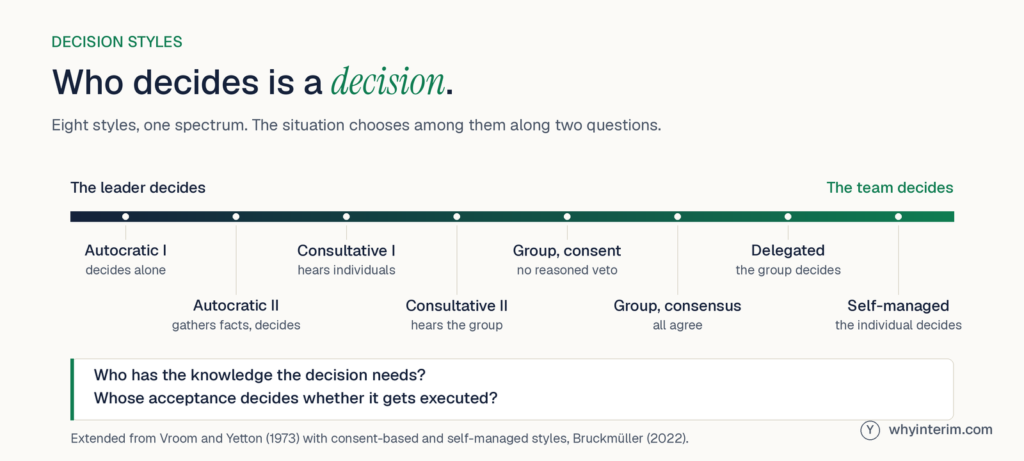
Figure 2. Who decides is a decision. The eight styles, extended from Vroom and Yetton (1973), and the two questions that choose among them.
What this means for you
- Pass intent down the line, and keep the how with the people closest to the information.
- Before delegating, ask two questions: who has the knowledge, and whose acceptance decides execution.
- Check how far your last major decision travelled before it reached the people affected, and how much of it arrived.
Keeping the loop short
Uncertainty rewards the faster learner. The clearest statement of why comes from John Boyd, the American fighter pilot turned strategist, who studied why F-86 pilots in Korea prevailed over technically comparable MiG-15s. His answer became the OODA loop: observe, orient, decide, act, and then observe again, because the action has changed the situation. Whoever cycles through the loop faster operates inside the opponent’s rhythm, and the slower party ends up responding to a situation that no longer exists.
Stripped of its military dress, the insight applies to any organisation facing a moving market. A quick decision followed by a quick correction outperforms a slow decision aimed at perfection, because the quick decider completes several learning cycles in the time the perfectionist needs for one. This is where Bezos’s 70 per cent threshold earns its keep. The residual 30 per cent of information arrives after the decision, through the decision, at the moment it is cheapest to obtain. And it is where his third rule, disagree and commit, does its quiet work, because a decision that is relitigated weekly never completes a single loop.
The number itself deserves an honest caveat. Nobody can measure 70 per cent of the information they wish they had, since the full set shows itself only in hindsight. Colin Powell wrapped the same instinct into his 40-to-70 rule for battlefield decisions, and both figures are postures dressed as percentages. Their real content is a reversal of the burden of proof. The decision stops waiting for the information, and the waiting has to justify itself against the clock. In a crisis the clock usually settles the question on its own. The decision point arrives from outside, set by the tide window, the covenant date, the creditor’s deadline, and the information level at that moment is simply whatever it is. Eisenhower launched with the forecast he had, because the forecast he wanted did not exist.
The information level at that externally set decision point is, however, open to preparation. The previous article in this series built the watch for exactly this reason. Scanning, leading indicators and strategic early warning bring a crisis into view while options still exist, so that when the clock forces the call, the decider arrives with months of signal on the table instead of a blank chart. Eisenhower’s forecast existed at all because a meteorological watch had been running long before anyone asked the question. Early recognition leaves the deadline where it is and raises the quality of what is known when it arrives.
The practical test for a leadership team is the length of its own loop. Some weeks pass between a signal from the market and a changed action in the field, and every one of those weeks has a price. In turbulent conditions, shortening that interval is worth more than refining any single decision inside it.
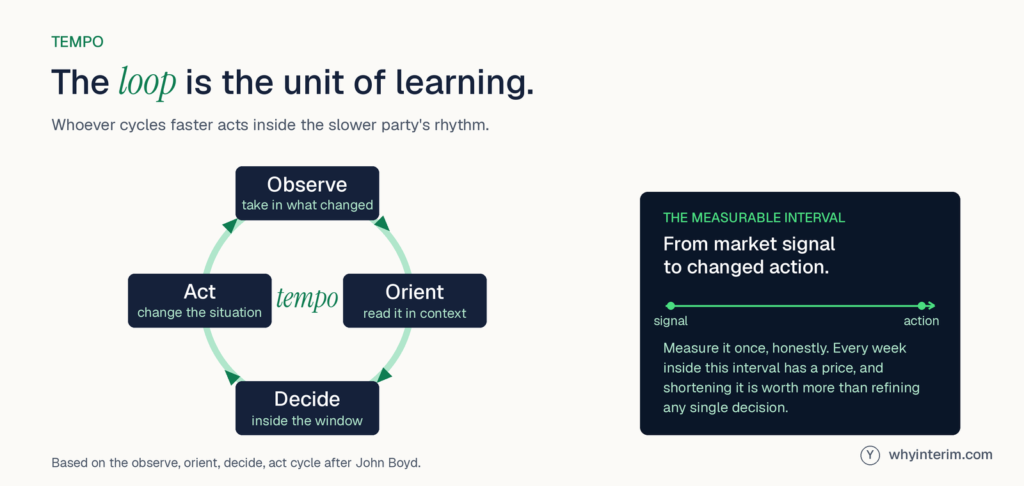
Figure 3. The loop is the unit of learning. Based on Boyd’s observe, orient, decide, act cycle.
What this means for you
- Measure the time from market signal to changed action in your organisation, once, honestly.
- Decide when the window demands it, and schedule the correction with a named date and owner.
- Close debates with disagree and commit, so the loop can actually turn.
Guarding the mind at the helm
One assumption deserves to be retired before this section begins, the assumption that a decision can be objective. Donald Hambrick and Phyllis Mason dismantled it in 1984 with their upper echelons theory. Executives never respond to the situation itself. They respond to a personal construal of it, filtered through their experience, their values, their cognitive base and, as later research added, their emotions and moods of the moment. Organisations therefore become reflections of their top managers, because every strategic choice passes through those filters on its way into the world. Victor Vroom’s expectancy-valence theory locates a second subjective layer inside the weighing itself. People evaluate options by the subjective probability of an outcome and by its personal attractiveness, which means personal goals travel alongside company goals into every choice, mostly without anyone noticing. A decision taken in a dark mood on a Friday evening differs from the same question examined on Tuesday morning, and the organisation inherits the difference. Every decision in this article’s craft, however well sorted and placed, is made by a particular person on a particular day, and carries their fingerprints.
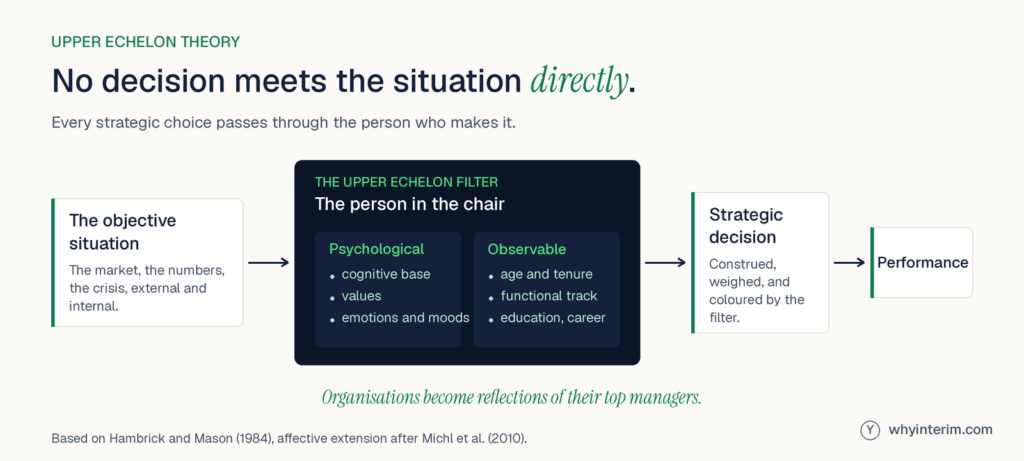
Figure 4. No decision meets the situation directly. Every strategic choice passes through the person who makes it. Based on Hambrick and Mason (1984), affective extension after Michl et al. (2010).
Daniel Kahneman supplied the mechanics of where the subjectivity bites hardest. His distinction between fast, intuitive thinking and slow, deliberate reasoning explains most known failure modes. Under stress and deadline, the fast system takes over, and it brings its habits: overweighting recent and vivid events, seeking confirmation, and trusting its own foresight too much. Pressure, in other words, widens exactly the subjective gap that the upper echelons describe.
Since the subjectivity cannot be removed, the countermeasures are structural rather than heroic, and they work by confronting one construal with others. Kennedy’s executive committee showed the strongest form: dissent by design, with the ranking person absent for part of the debate so that juniors could attack the plan. The pre-mortem, covered in the previous article of this series, does the same work in a single meeting by making failure the official assumption. For the heavier calls, a decision memo of a single page, stating the situation, the options, the assumptions and the reasoning, disciplines the fast system simply by slowing the hand, and it makes the decider’s construal visible enough to be questioned. The everyday two-way doors need no such apparatus. My thesis adds one caution from the data. Emotion travels poorly down the scalar chain, so a decider several layers up should assume that neither their confidence nor their concern arrives intact, and should say in words what they expect the tone to say for them.
What this means for you
- Treat your reading of the situation as one reading, and ask who at the table sees a different one.
- Build dissent into the process, and remove rank from the room while the plan is attacked.
- Before the heavy calls, write the one-page memo, with assumptions and your own stake stated openly.
Reversing your own decision
The hardest decision under uncertainty is often the second one, the reversal of a call that has visibly stopped working. Barry Staw named the pattern in 1976 as escalation of commitment: once people have invested money, effort and reputation in a course of action, negative feedback tempts them to invest more, because admitting the loss feels worse than growing it. The behaviour has a famous European monument. The British and French governments kept funding Concorde long after the numbers showed the aircraft would never repay them, which is why researchers borrowed its name for the sunk-cost fallacy itself.
Folk wisdom compressed Staw’s finding into a single image long before the research existed. When you discover you are riding a dead horse, the proverb advises, dismount. Corporate life has added its own satirical appendix, a circulating list of the strategies organisations prefer instead: buying a stronger whip, changing the rider, appointing a committee to study the horse, visiting other companies to learn how they ride dead horses, and finally redefining what dead means. The list is a joke, and every experienced manager has watched at least three of its items performed in earnest. Each one is escalation of commitment in a business suit, and each one costs more than the dismount.
The escape is a change of perspective, and the cleanest demonstration of a leader dismounting comes from Silicon Valley. In 1985, Intel was being bled dry in memory chips by Japanese competitors, and the company’s identity was built on memories. Andy Grove asked Gordon Moore what a new chief executive would do if the board replaced them both. Moore answered without hesitation that a newcomer would take Intel out of memories. Grove’s response, recounted in Only the Paranoid Survive, was to suggest they walk out the door, come back in, and do it themselves. The thought experiment worked because it stripped away the sunk costs. A newcomer inherits the situation without the history, sees only the decision in front of them, and judges it on its merits. Intel left memories, bet the company on microprocessors, and built the following two decades on that reversal.
Reversibility, in other words, is only valuable to the leader who actually uses it. A two-way door through which nobody is willing to walk back is a one-way door with better marketing. The discipline that keeps the door genuinely open is set at the moment of the original decision: a clearly stated trigger naming what evidence would prove the call wrong, written down where the weight of the decision demands it, a named date on which the question is reopened, and the shared understanding in the team that a decision reversed on new evidence is craft, while a decision defended against the evidence is vanity. Eisenhower postponed the invasion once before he launched it. The postponement and the launch were the same competence.
What this means for you
- At the moment of deciding, state what evidence would prove the decision wrong, and record it for the calls that matter.
- Put the review in the calendar, with a date and an owner, before the first euro is spent.
- When the evidence arrives, ask what a successor would do, and then do it yourself.
Why deciding early is worth it
So, how much certainty may a leader wait for before a decision stops being prudent and starts being late?
The answer has assembled itself across the sections. A leader waits as long as the grade of uncertainty rewards analysis, and acts the moment it stops. A leader waits longer at one-way doors and barely at all at two-way doors, because the door sets the pace. A leader places each decision where the information lives, so that most decisions never need to wait for the top at all. A leader keeps the learning loop short, because the missing information is usually cheaper to collect after the decision than before it. A leader guards the mind that decides, since every decision is subjectively coloured and pressure widens the colouring precisely when judgement matters most. And a leader stays willing to reverse, because the value of a two-way door lies entirely in the willingness to walk back through it.
Eisenhower needed all of it on a single June night. The forecast was uncertain, the window was closing, the room was divided, and the note accepting failure was already written. He decided, and the decision made the weather bearable.
Certainty is a luxury of hindsight. Judgement on adequate information, exercised inside the window, is the working standard of leadership.
Every decision accepts risks, and naming and pricing those risks is a craft of its own, which the next article in this series takes up.
Further reading
Deciding under uncertainty
- Hugh Courtney, Jane Kirkland & Patrick Viguerie: Strategy Under Uncertainty, Harvard Business Review (1997)
- Jeff Bezos: 2015 and 2016 Letters to Shareholders, Amazon
- Graham Allison & Philip Zelikow: Essence of Decision: Explaining the Cuban Missile Crisis, Longman (2nd edition, 1999)
- Colin Powell with Joseph E. Persico: My American Journey, Random House (1995)
- Tim Rives: “OK, We’ll Go”: Just What Did Ike Say When He Launched the D-day Invasion?, Prologue Magazine, US National Archives (2014)
Mission command and decision styles
- Daniel J. Hughes & Harry Bell (eds.): Moltke on the Art of War: Selected Writings, Presidio Press (1993)
- Victor Vroom & Philip Yetton: Leadership and Decision-Making, University of Pittsburgh Press (1973)
- Robert Coram: Boyd: The Fighter Pilot Who Changed the Art of War, Little, Brown (2002)
- Andreas Bruckmüller: Zentrale vs. Dezentrale Unternehmensführung: Relevanz und Einfluss des Führungsstils, Master’s thesis, KMU Akademie / Middlesex University (2022)
The mind of the decider
- Daniel Kahneman: Thinking, Fast and Slow, Farrar, Straus and Giroux (2011)
- Donald Hambrick & Phyllis Mason: Upper Echelons: The Organization as a Reflection of Its Top Managers, Academy of Management Review (1984)
- Theresa Michl, Isabell Welpe, Matthias Spörrle & Arnold Picot: Der Einfluss affektiver Zustände auf den strategischen Entscheidungsfindungsprozess, in: Managementforschung 20, Gabler (2010)
- Barry M. Staw: Knee-Deep in the Big Muddy: A Study of Escalating Commitment, Organizational Behavior and Human Performance (1976)
- Gary Klein: Performing a Project Premortem, Harvard Business Review (2007)
- Andrew S. Grove: Only the Paranoid Survive, Currency Doubleday (1996)
- Fredmund Malik: Führen, Leisten, Leben, Campus (2006)