

More than four out of five corporate reorganisations fail to deliver the value they were meant to, in the time that was planned, and about one in ten leave the company measurably worse off, according to a McKinsey survey. Those numbers should unsettle anyone who has ever redrawn an org chart in a hurry, because they say something uncomfortable about structure. Far from being mere administration, structure is a decision, and like every decision it is judged by what happens next.
In calm conditions the shape of an organisation barely shows. Reporting lines hum along, the work moves through them, and nobody asks whether the design is right. Pressure changes that. When a market turns, a supplier fails, or a regulator moves, the structure stops being background and becomes destiny. Some forms absorb the shock and keep deciding. Others freeze, defend the process, and wait for instructions that arrive too late. That difference was built in long before the shock, on a quiet afternoon when someone chose how the place would be run.
The old answers, still running the place
Two ideas shaped how most companies are still organised, and both are worth knowing by name.
The first belongs to Henri Fayol, a French mining engineer who spent his career turning a failing colliery into a profitable one and then, in 1916, wrote down what he had learned. His General and Industrial Management gave the field its first real grammar: division of work, a clear chain of authority from top to bottom, and above all unity of command, the rule that each person answers to a single boss. Fayol made the case for authority that flows down from position. For a factory in a stable century, the logic held well.
The second idea arrived in 1960, when Douglas McGregor of MIT asked a deceptively simple question: what does a manager actually assume about the people being managed? He named two answers. Theory X assumes that people avoid work and need to be directed and controlled. Theory Y assumes that people are self-directed and will take responsibility when the conditions allow it. Every structure encodes one of these assumptions, usually without admitting it. A command hierarchy leans on Theory X. Decentralisation rests on Theory Y.
These two ideas still run quietly underneath most companies, and they reassert themselves hardest under pressure. When the alarm sounds, decisions rush upward. Authority contracts toward the top, on the instinct that control means safety. Sometimes that instinct is right. Often it is where the trouble starts.
Five shapes, and how each meets a shock
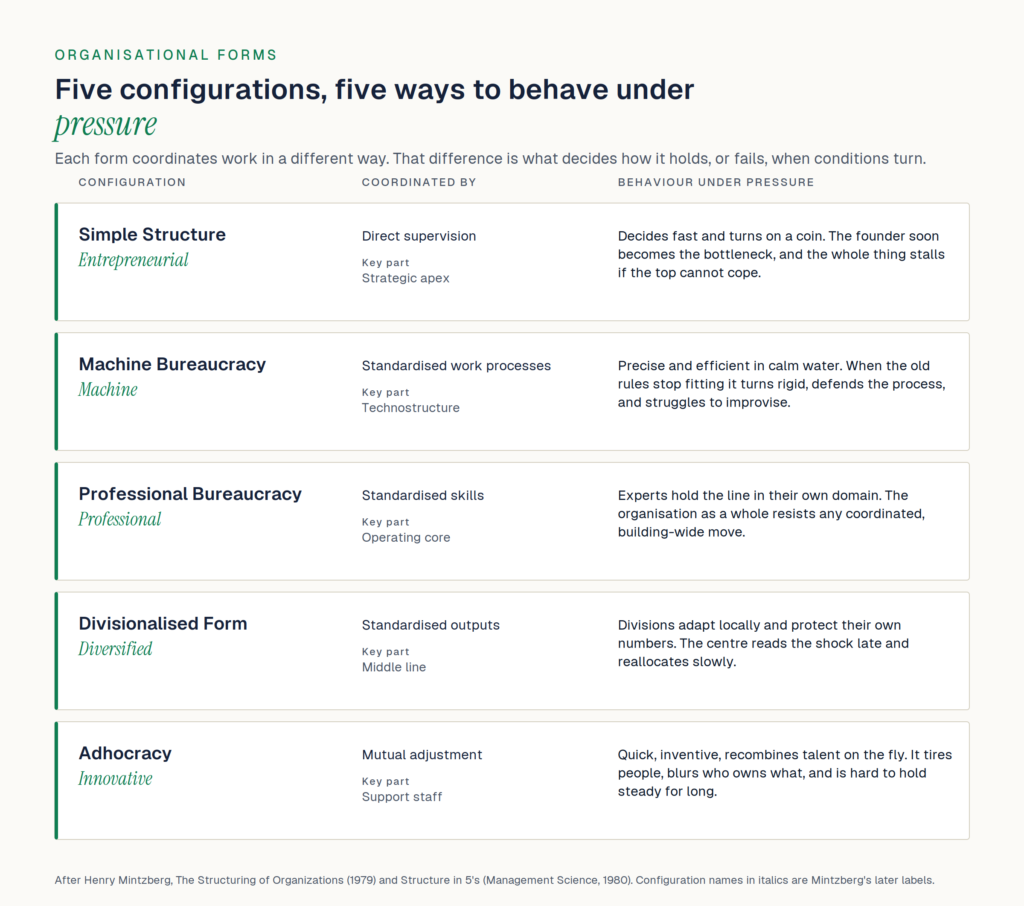
Henry Mintzberg drew the clearest map of the shapes themselves. In The Structuring of Organizations in 1979, and in a paper the year after with the memorable title Structure in 5’s, he argued that organisations tend to cohere around a small number of configurations, each built on a different way of coordinating work. The labels matter less than the behaviour, and the behaviour shows most clearly under stress.
A Simple Structure runs on direct supervision from one leader. It decides fast and changes direction on a coin, which is its great strength in a young company. Under sustained pressure the founder becomes the bottleneck, and if the top cannot cope, everything stalls behind it.
A Machine Bureaucracy coordinates through standardised processes, and in stable conditions it is precise and efficient. When the old rules stop fitting the new situation, it turns rigid, defends the process, and struggles to improvise the very thing the moment demands.
A Professional Bureaucracy relies on the standardised skills of its experts, the hospital and the university being the obvious examples. Its specialists hold the line in their own domains with real competence, while the organisation as a whole resists any coordinated, building-wide move.
A Divisionalised Form coordinates through standardised outputs, with each division measured on its own numbers. Divisions adapt locally and protect their results, yet the centre often reads a system-wide shock late and reallocates resources slowly.
An Adhocracy coordinates through mutual adjustment, the constant informal conversation of people solving a problem together. It is quick, inventive, and recombines talent on the fly, which is why it suits turbulent, creative work. It also tires people, blurs who owns what, and is hard to hold steady for long.
A structure that runs perfectly in calm water tells you very little about how it will behave in a storm.
In calm conditions no configuration is best, and each is good at something and exposed somewhere. Under pressure the picture sharpens. The forms that can move a decision to the people who hold the knowledge tend to come through, while the rigid, process-bound machine bureaucracy tends to struggle most, because the very thing that makes it efficient in steady times, its fixed standard procedure, is what fails it once the situation stops following the script. The real mistake is defending the form you happened to inherit as though no other were available.
What this means for you
Diagnose the shape you actually have, not the one on the chart. The real configuration shows in how work gets coordinated: by a boss, by a process, by expertise, by the numbers, or by conversation. Name yours, then name its failure mode, the way it tends to behave when a shock lands. Knowing that in advance is already half of the response.
Where the good decisions actually sit
Once the shape is clear, the harder question follows. Where in the structure should a decision be made?
The case for pushing decisions downward is not sentimental. It rests on a plain observation: information is never complete at the top. The people closest to a customer, a machine, or a market often know things the executive floor cannot know in time. When a decision has to be made quickly and made well, it belongs where the knowledge and the competence already sit. That is what meritocracy means in an organisational sense. Authority follows capability and proximity to the problem, not position on a chart.
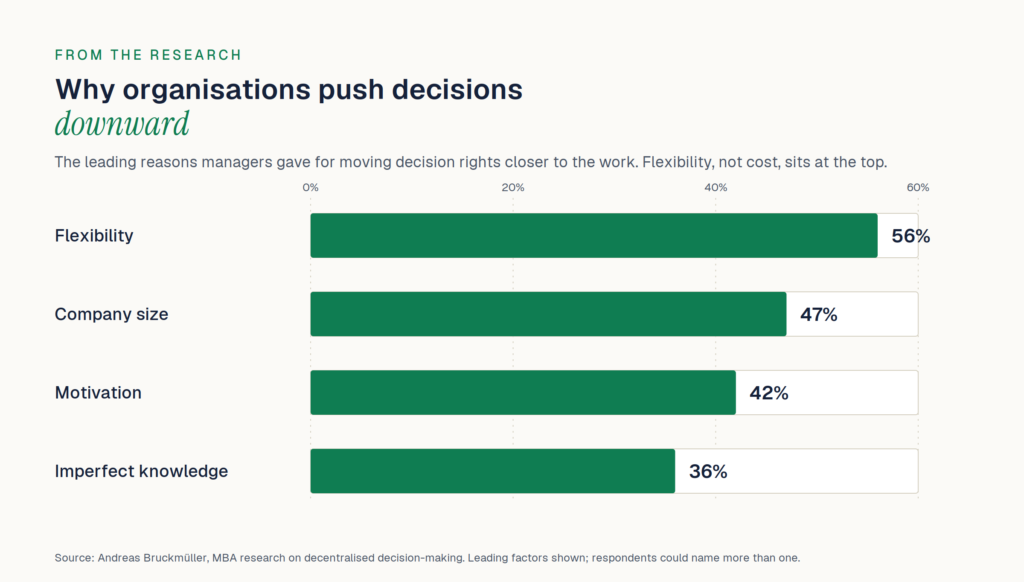
This is also what managers themselves report. In research I carried out on decentralised decision-making, the reasons leaders gave for moving authority downward put flexibility at the top, named by more than half of them, ahead of company size and motivation, with the simple fact of imperfect knowledge close behind. Cost barely featured. The driver was the ability to respond.
McGregor’s Theory Y sits underneath all of this, and a more recent voice reinforces it. In New Work, the German author Michael Hübler argues that agile, democratic ways of working should arrive as evolution rather than revolution, and he leans on the consent principle: a proposal moves forward as soon as no one holds a serious objection. That single rule keeps a decentralised organisation quick without turning every choice into a debating society. Direction still comes from the top. The decisions simply land closer to the work.
What this means for you
Send each decision to the level that holds the knowledge to make it well, and say so out loud, so the people there know the call is theirs. Then write down the short list of decisions that must stay at the top: capital, safety, and direction. Clarity about both lists matters more than exactly where the line is drawn.
The cases everyone quotes, and what they actually show
Four companies get cited whenever this subject comes up. Each is more instructive than its legend.
Ricardo Semler took over the Brazilian manufacturer Semco around 1980 and dismantled most of its hierarchy. Employees set their own salaries, chose and rated their managers, and saw every financial figure. Semco grew strongly for years, which is the part people remember. The part they forget is that it rested on total commitment to the system and on an owner willing to give up control, conditions few imitators have matched. Semler’s own verdict was that the parts cannot be cherry-picked.
Spotify published a model in 2012 built on autonomous squads, tribes, and guilds, and the engineering world fell in love with it. Then a former employee, Jeremiah Lee, set the record straight in 2020: the famous model was aspirational, never fully implemented even at Spotify, and the company had been drifting toward more conventional management while the diagrams went viral. Autonomy without enough alignment had produced fragmentation. The lesson is plain. Autonomy needs coordination, or it splinters.
Valve, the games company, has been boss-free since 1996, with desks on wheels so people can roll over to whatever project interests them. Former employees tell a more complicated story. Beneath the flat surface ran an informal power structure, and more than one described the experience of needing to belong to the right group as something close to high school. A structure with no visible hierarchy still has one. It is simply unwritten, which can make it harder to question.
Zappos went furthest. In 2015 its chief executive, Tony Hsieh, told staff to commit fully to a self-management system called Holacracy or accept a generous severance, and around eighteen per cent of the company left. By 2020 the firm had quietly stepped back from the full system. A structure adopted as an ideology tends to break on contact with a real organisation, while a structure chosen as a fit can hold.
Structure is a decision, and pressure moves the answer
Richard Burton and his colleagues, in the standard modern text on the subject, state the principle precisely. There is no universally best structure. There is only fit, a match between the work, the environment, and the way the organisation coordinates and controls itself, and misfit quietly costs performance. In a stable world, fit tends to favour the centralised, standardised forms, because efficiency is the prize. As conditions grow turbulent, fit shifts toward competence and proximity, because speed and judgement at the edge become the prize instead.
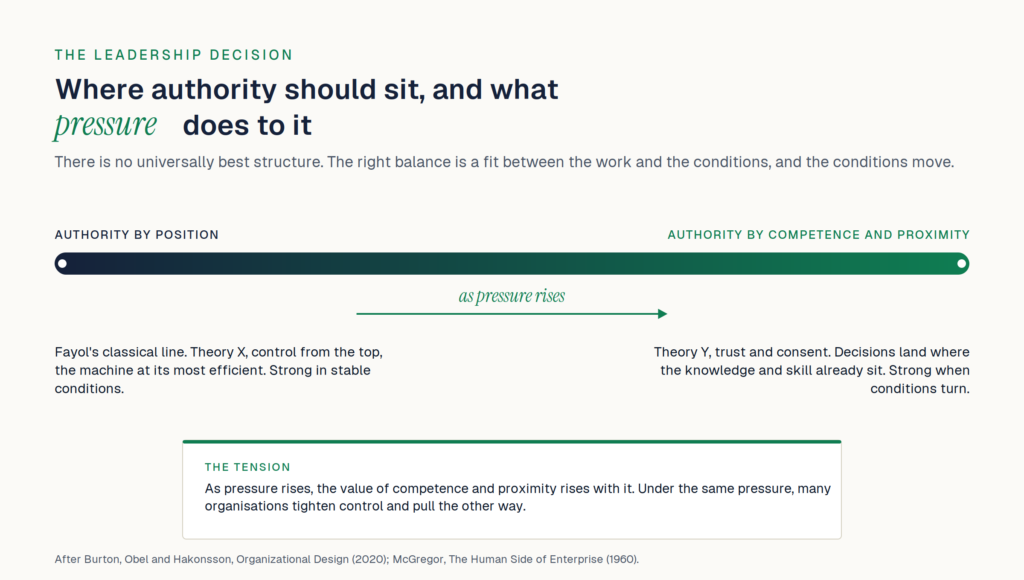
For a series about leading through crisis, that yields a plain verdict. When the pressure comes, the organisations that bend tend to survive it, and the ones built to stand rigid tend to crack. Adaptable, decentralised forms move faster and decide closer to the facts, which is what a crisis rewards. The machine bureaucracy, so dependable in steady conditions, is the most exposed, because its strength is a fixed procedure and a crisis is the situation that procedure never anticipated. One honest qualification belongs here. This holds when conditions turn turbulent. In a stable market the disciplined, centralised form often wins on efficiency, and the research has long carried the same finding: hierarchy serves well when conditions hold steady and comes under strain when they turn.
Here lies the uncomfortable part, and the research is clear about it. The stated trend in most organisations points toward decentralisation and broader participation. The substance often tells a different story. In the survey work behind this piece, the decisions that mattered most still sat with top management, and the culture was experienced across the organisation as fairly authoritarian. So the value of pushing authority downward rises exactly when pressure rises, and that is precisely the moment many organisations pull it back up. The reflex to centralise feels like control. It frequently removes the judgement the situation needs.
One more finding from that work deserves a place here. Leadership lands hardest when it is direct and personal. The further a decision-maker sits from the people affected, the more time has to be spent on communication and participation to achieve the same effect. Distance carries a cost, and the cost is paid in clarity.
What this means for you
Decide the shape before the shock, not during it. Choose the form that fits your work and your conditions, write down the few decisions that escalate and the many that do not, and then, when conditions turn, revisit the design on purpose rather than by reflex. The organisation that decides where the knowledge sits will be moving while others are still waiting for instructions.
The shape you chose is the shape you get
Structure is the quietest decision a leader makes, and one of the most consequential. It is set once, usually early, and then it shapes every decision that follows, above all the ones made in a hurry when the pressure is on. The companies that come through turbulence well are rarely the ones with the cleverest chart. They are the ones whose shape lets the right people decide quickly, and whose leaders chose that shape deliberately.
So the question to carry into the week is a structural one. When the next shock arrives, will your organisation decide where the knowledge sits, or only where the title does?
Leading Through Turbulence is a series on the principles leaders rely on when they cannot wait for calmer times. This is Part 4.
Further reading
Theory and design
- Mintzberg, H. (1980). Structure in 5’s: A Synthesis of the Research on Organization Design. Management Science, 26(3), 322–341. The 1979 book The Structuring of Organizations sets out the full argument. Read the paper
- Fayol, H. (1916 / 1949). General and Industrial Management. London: Pitman. Reference
- McGregor, D. (1960). The Human Side of Enterprise. New York: McGraw-Hill. Read online
- Burton, R. M., Obel, B., & Håkonsson, D. D. (2020). Organizational Design: A Step-by-Step Approach (4th ed.). Cambridge University Press. Publisher
- Hübler, M. (2018). New Work: Menschlich – Demokratisch – Agil. Regensburg: metropolitan. Reference
Evidence
- McKinsey & Company. Reorganizing to capture maximum value quickly. Read the article
- Keller, S. & Schaninger, B. (2016). Getting Reorgs Right. Harvard Business Review. Read the article
Cases
Groth, A. (2020). Zappos has quietly backed away from holacracy. Quartz. Read the article
Semler, R. (1993). Maverick. The Semco story of workplace democracy. Reference
Lee, J. (2020). Spotify’s Failed #SquadGoals. Read the analysis
People Make Games / PC Gamer (2021). Inside Valve’s flat structure. Read the report