

Two Modes, One Discipline
Part of the series Leading Through Turbulence.
In August 1997, Steve Jobs walked onto a stage at Macworld Boston to announce that Apple had accepted a 150 million dollar investment from Microsoft. The audience booed. Apple was weeks from running out of cash. Within months, Jobs would cut 70 percent of Apple’s product lines, reducing more than 350 projects to ten. Most observers read this as a rescue, a textbook case of crisis response. In retrospect, it looks like the opening move of one of the most successful strategic repositionings in modern business history.
Both readings are correct. That is the point. Crisis response and strategic adaptation are not opposites.
They often arrive in the same month, sometimes in the same meeting. But they are different disciplines. They operate on different time horizons, require different decision patterns, and ask for different things from the people who lead them. Confusing them is one of the most common and most expensive leadership errors in turbulent periods.
This article sets out the distinction, grounds it in the research, and then looks at three leaders who moved between the two modes with unusual clarity.
What the research actually says
The management literature treats these as two distinct constructs, not two points on a spectrum.
A crisis, in the canonical definition by Pearson and Clair (1998), is a low-probability, high-impact event with ambiguous causation, perceived to threaten an organisation’s viability and requiring decisions under severe time pressure. Bundy, Pfarrer, Short and Coombs (2017) refined the definition around three features: threat to central organisational goals, element of surprise, and decision urgency. Crisis response is the set of actions aimed at containment, stabilisation and the restoration of operational capacity. Its horizon is measured in hours to weeks.
Strategic adaptation has a different intellectual lineage. The term emerges from evolutionary organisation theory (Hannan and Freeman, 1984) and was extended by the dynamic capabilities school, particularly Teece, Pisano and Shuen (1997). Strategic adaptation is the directed reconfiguration of business model, resources and structures in response to shifting environmental conditions. It happens under uncertainty, but not under existential pressure. Its horizon is measured in quarters and years.
The difference matters because it prescribes different leadership behaviours. A crisis calls for centralisation, directness and visible stability. A strategic adaptation calls for distribution of authority, iterative experimentation, and a tolerance for ambiguity that would be dangerous during an acute crisis.
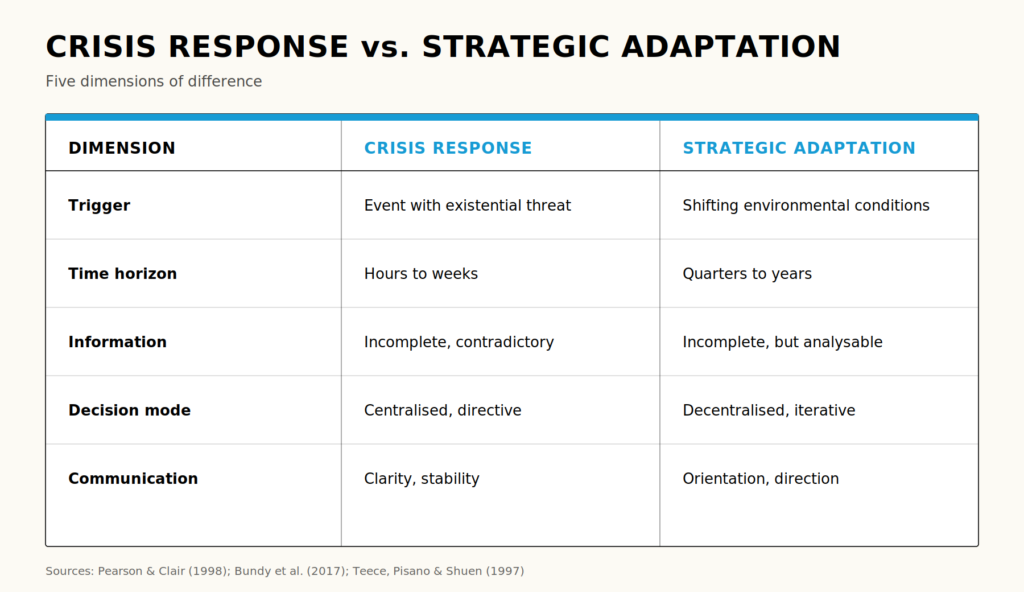
Figure 1. Five dimensions along which crisis response and strategic adaptation differ. Adapted from Pearson and Clair (1998), Bundy et al. (2017), Teece, Pisano and Shuen (1997).
From moratorium to architecture
Franklin Roosevelt took office on 4 March 1933 with the American banking system in free fall. By Monday morning, he had declared a four day bank holiday. By Thursday, Congress had passed the Emergency Banking Act. The goal in that first week was not reform. It was to stop the bleeding. This was crisis response in its purest form: centralised, direct, visibly in command, aimed at restoring confidence in the mechanics of daily life.
The Hundred Days that followed looked different. The Civilian Conservation Corps, the Tennessee Valley Authority, the Agricultural Adjustment Act and, later, the Social Security Act of 1935 were not stabilisation measures. They were institutional redesign, attempts to change the structural terms on which the American economy and social contract operated. Roosevelt kept the emergency tone in his fireside chats but shifted the substance of his work from stopping a collapse to building something new.
What distinguished Roosevelt was the sequencing. He did not try to do both in the same week. The banking moratorium preceded the Social Security Administration by more than two years. The crisis mode ended explicitly before the adaptation mode began in earnest. Leaders who read Roosevelt as a perpetual improviser miss the structural discipline underneath the improvisation.
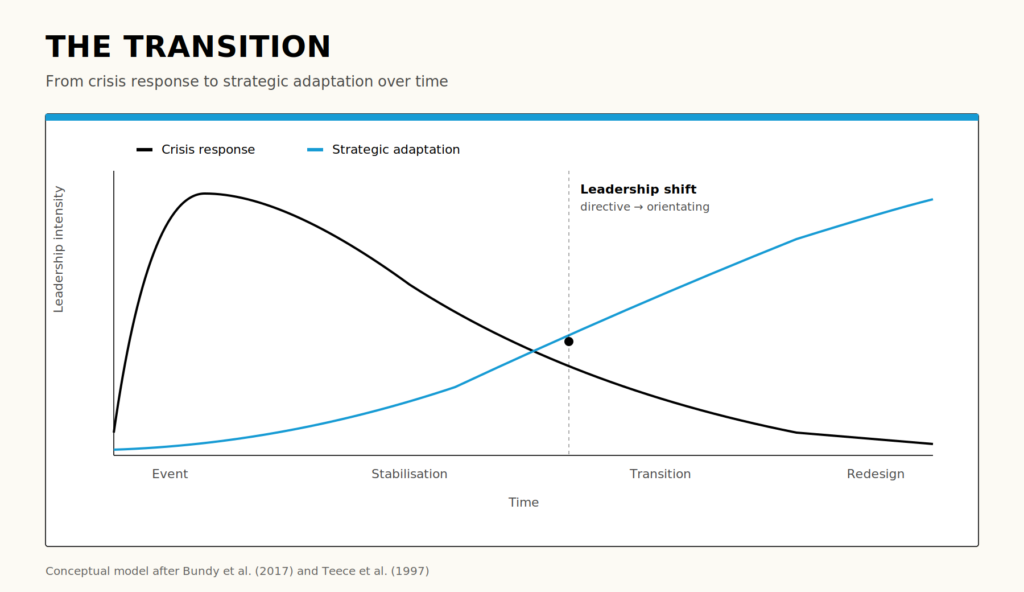
Figure 2. A conceptual model of the transition. Crisis response dominates early and declines as stabilisation succeeds. Strategic adaptation rises more slowly but lasts longer. The inflection point marks a shift in leadership style.
| WHAT THIS MEANS FOR YOU |
| • Separate stabilisation from redesign. Do not attempt both in the same meeting. |
| • Communicate short-term measures differently from long-term direction. One asks for compliance. The other asks for engagement. |
| • Set an explicit end date for crisis mode and name what comes after. Ambiguity here is expensive. |
The most common mistake
Managers tend to fail in one of two directions. The first is to treat strategic adaptation as if it were a crisis. Tempo becomes panic. Decisions get centralised when they should be distributed. Communication turns urgent when it should turn reflective. The organisation becomes exhausted by a crisis response that never ends, because the underlying situation was never a crisis to begin with.
The second is to treat a crisis as if it were a strategic project. Too many stakeholders are consulted. Too much analysis is commissioned. Decisions are deferred in the name of rigour while the operational situation continues to deteriorate. By the time a direction is chosen, the facts have moved.
Peter Drucker’s question from The Theory of the Business (1994) helps separate the two cases. Drucker asked, what is our business, who is our customer, and what do they value? If the honest answer is that the theory is still sound but the immediate situation is unstable, the problem is a crisis. If the honest answer is that the theory itself no longer fits reality, the problem is strategic adaptation. Mistaking one for the other is not a communication failure. It is a diagnostic failure.
Crisis as catalyst
When the first oil shock hit in October 1973, the Japanese automobile industry was extraordinarily exposed. Energy costs rose sharply, demand collapsed, and the entire post-war model of continuous volume growth came into question. Toyota responded on two tracks at once, and the distinction between them is what made the response historically consequential.
On the first track, Toyota did what any competent management would do under acute pressure. Production was cut, inventories were tightened, cost discipline was enforced throughout the supply base. This was crisis response, short-horizon and direct.
On the second track, something more interesting happened. The reduced level of activity gave Taiichi Ohno and his colleagues the organisational space to institutionalise practices that had been developing in pockets of Toyota since the 1950s. The Toyota Production System, with its emphasis on just-in-time production, waste elimination and built-in quality, moved from being a set of local techniques to being the operating system of the company. Ohno himself, in Toyota Production System (1988), dates the full spread of the method across Toyota to the years immediately following the oil shock. Womack, Jones and Roos, in The Machine That Changed the World (1990), documented how this transformation made Toyota the global benchmark for lean manufacturing by the mid-1980s.
The lesson is not that crises are opportunities. That cliché flatters leaders who get lucky. The lesson is more precise. A crisis creates conditions in which existing, underused capabilities can be institutionalised faster than they would be in normal times. Toyota did not invent lean in 1973. Toyota made lean inevitable in 1973.
| WHAT THIS MEANS FOR YOU |
| • Identify which existing capabilities a crisis lets you institutionalise faster. The answer is rarely zero. |
| • Use reduced activity as time for structural work, not only for cost cuts. The cost cuts are forced on you. The structural work is a choice. |
| • Name the strategic ambition before the crisis ends, not after. Leaders who wait to declare direction until the storm passes lose the window. |
Shell 1973: preparation shortens the crisis
Shell entered the same oil shock from a different starting position. Since 1971, under Pierre Wack and Ted Newland, the company’s Group Planning department had been running scenario planning exercises with senior management. The scenarios did not predict an embargo. What they did was rehearse the mental model. When the Yom Kippur War broke out in October 1973 and OPEC imposed its embargo, Shell executives had already thought through a world in which oil-producing nations used supply as a political instrument.
The operational consequence was that Shell’s crisis response phase was shorter and more controlled than its competitors’. Prices and supply commitments were adjusted earlier. Capital allocation moved faster. Wack described the purpose of scenarios in his 1985 Harvard Business Review article as a way to change the microcosm, the mental model, of decision makers, not to predict outcomes. The preparation was not about forecasting the future correctly. It was about shortening the time between event and informed action.
It is worth being honest about the historiography. The popular story that scenario planning propelled Shell from a middling position to near the top of the industry is hard to verify causally. Wilkinson and Kupers, writing in the Harvard Business Review in 2013 from inside Shell’s own scenario team, warn against the mythology. What is documented is more modest and more useful. Shell institutionalised a method of thinking about uncertainty that served it across multiple shocks, from the 1979 price rise to the 1986 oil market collapse and the end of the Soviet Union. Preparation did not predict. It compressed reaction time.
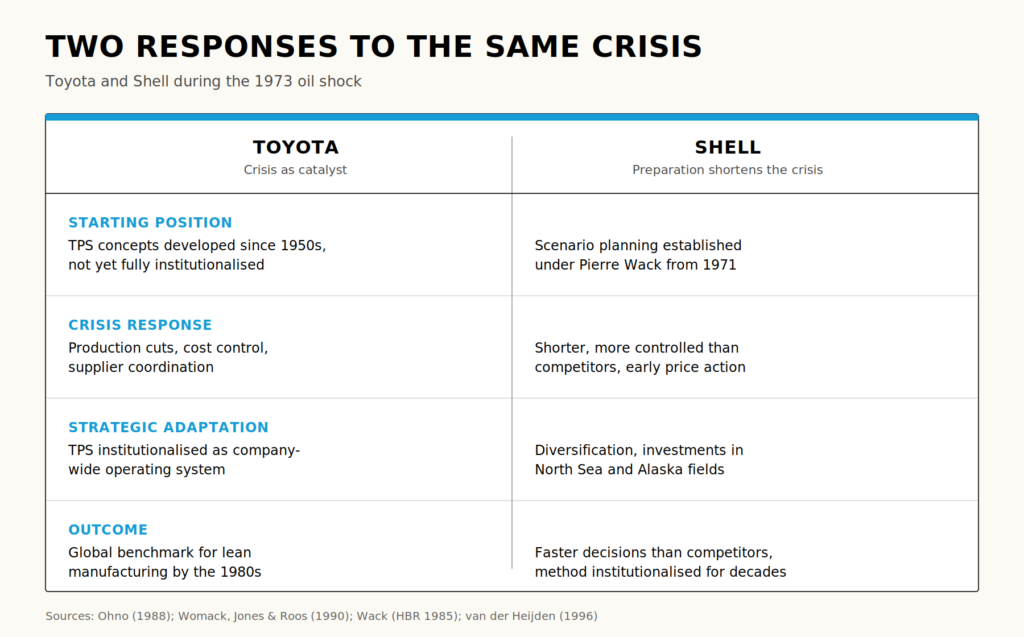
Figure 3. Toyota and Shell during the 1973 oil shock. Toyota used the crisis as a catalyst for institutionalising an existing capability. Shell used prior preparation to shorten its crisis response phase. Both paths illustrate disciplined movement between the two modes.
| WHAT THIS MEANS FOR YOU |
| • Build scenarios in stable periods, not when you need them. Under pressure, there is no time to learn the method. |
| • Rehearse decisions before you have to make them. The rehearsal itself is the value, not the accuracy of the scenario. |
| • Accept that preparation does not predict. It shortens reaction time. That is usually enough. |
A practical diagnostic
Three questions, asked honestly, will usually tell a leader which mode is appropriate.
First, what is the time horizon? If the relevant horizon is measured in hours and weeks, the situation is a crisis, and the response should be centralised and direct. If the horizon is measured in quarters and years, the situation is strategic, and the response should be more distributed.
Second, what is the primary task? If the primary task is to prevent something from getting worse, the mode is crisis response. If the primary task is to move the organisation toward something better, the mode is strategic adaptation. Both can be true in sequence, as Roosevelt showed, but rarely at the same moment.
Third, what does the organisation need from its leadership? If the answer is clarity and stability, the mode is crisis response. If the answer is orientation and direction, the mode is strategic adaptation. Getting this wrong is the fastest way for a leader to lose credibility, because people can feel the mismatch before they can articulate it.
These questions are not new. What is new is the insistence that a leader must be able to ask them in real time, often several times a quarter, and must be willing to change modes as the answers change. Toyota and Shell both show, in different ways, that the movement between modes is itself a capability. It can be prepared for, in Shell’s case, or compressed by discipline, in Toyota’s case. It cannot be improvised indefinitely.
Back to Cupertino
The Apple story that opened this article makes more sense in this frame. Jobs cut the product line because he had to. That was crisis response. He cut it in a particular shape, aimed at four products serving four customer segments, because he already had a view of what Apple should become. That was strategic adaptation. The two decisions looked like one decision because they happened in the same weeks. But the leadership capabilities underneath them were different.
Leaders who can distinguish crisis response from strategic adaptation do both well. Leaders who can move between them with discipline hold an advantage that compounds over time.
Crisis response and strategic adaptation are not the same discipline. Mistaking one for the other is the most expensive leadership error in turbulent periods.
In turbulent periods, the question is not whether to act fast or think long. It is which mode the situation actually calls for, and whether you can switch when it changes.
The question to take into your next week is simple. Which mode are you in, and is it the right one?
Further reading
STRATEGY & MANAGEMENT
- Taiichi Ohno: Toyota Production System: Beyond Large-Scale Production (1988)
- James P. Womack, Daniel T. Jones & Daniel Roos: The Machine That Changed the World (1990)
- Kees van der Heijden: Scenarios: The Art of Strategic Conversation (1996)
ACADEMIC ARTICLES
- Michael T. Hannan & John Freeman: Structural Inertia and Organizational Change, American Sociological Review (1984)
- Pierre Wack: Scenarios: Uncharted Waters Ahead, Harvard Business Review (1985)
- Peter F. Drucker: The Theory of the Business, Harvard Business Review (1994)
- David J. Teece, Gary Pisano & Amy Shuen: Dynamic Capabilities and Strategic Management, Strategic Management Journal (1997)
- Christine M. Pearson & Judith A. Clair: Reframing Crisis Management, Academy of Management Review (1998)
- Angela Wilkinson & Roland Kupers: Living in the Futures, Harvard Business Review (2013)
- Jonathan Bundy, Michael D. Pfarrer, Cole E. Short & W. Timothy Coombs: Crises and Crisis Management: Integration, Interpretation, and Research Development, Journal of Management (2017)
HISTORICAL LEADERSHIP
- Walter Isaacson: Steve Jobs (2011)
- Jean Edward Smith: FDR (2007)