
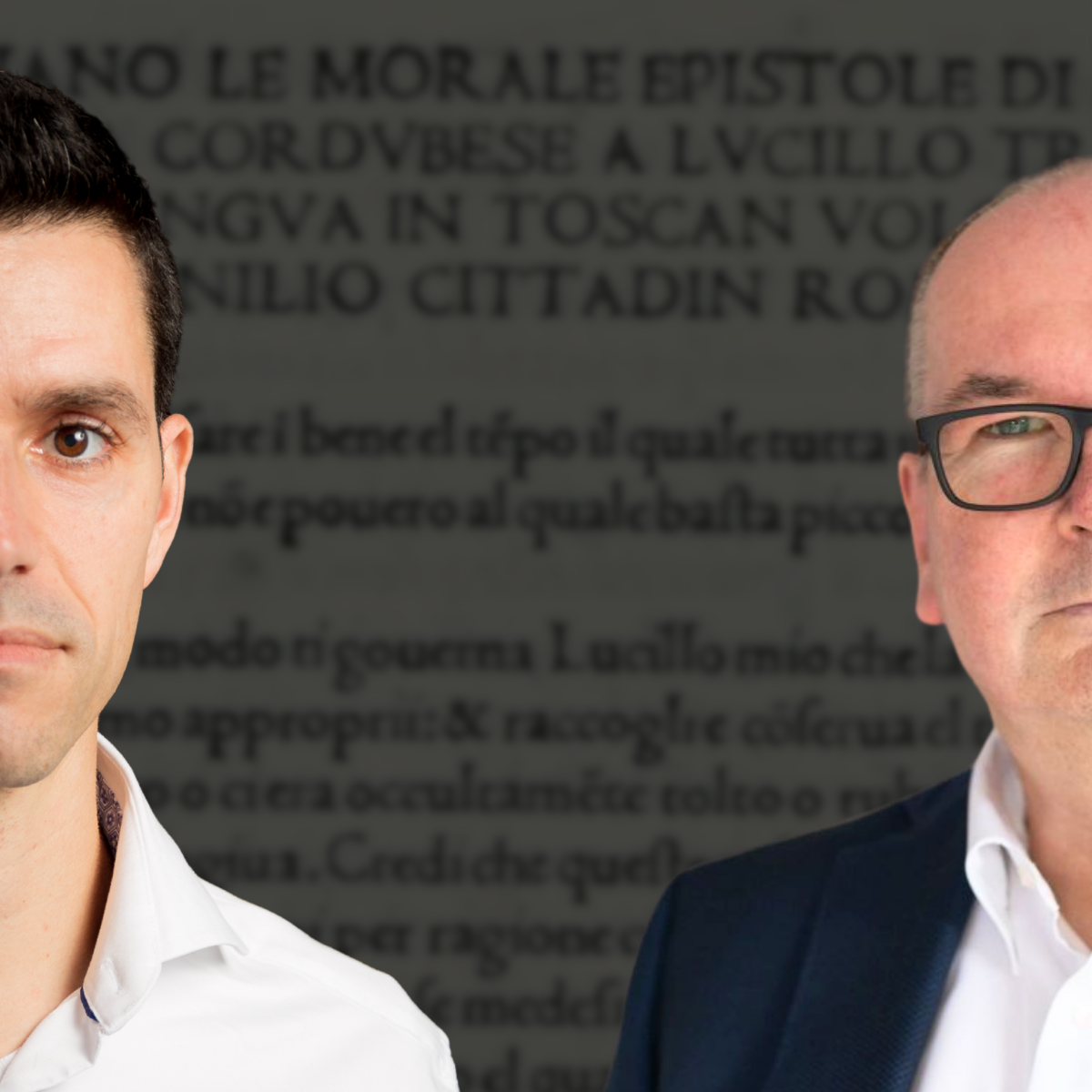
Eighth letter from Andreas to Michael
Dear Michael,
you have made me optimistic. That is no small feat.
Seven letters of honest diagnosis, dependency, erosion, division, silence, and now this: a catalogue of initiatives, capital, momentum. I read your letter twice. The second time more slowly. And I found myself agreeing with almost everything. Almost.
Because here is the thought that stayed with me after I put your letter down:
Europe is not only a place. Europe is an idea of unification. Europe is all of us. Even non-Europeans.
Every person who builds something, who refuses to wait, who shows up and does the work. The intellectual capacity you describe, the researchers, the engineers, the humanist tradition, that is not a continental resource. It is a human one. And that shifts the question entirely. Not: does Europe have what it takes? But: do we?
Which brings me to a provocation your letter contains, though you did not intend it. You list the initiatives, InvestAI, EuroStack, the digital euro. Impressive. Real. But I have spent enough time in rooms where brilliant people with excellent ideas produced nothing, to know one thing with certainty:
Intellectual capacity is the beginning of the story, not the end.
The rest of the world, Michael, is also cooking with water. Silicon Valley did not succeed because its engineers were smarter than ours. It succeeded because of something else. And that something else is not a question of geography. It is a question of attitude toward life, toward risk, toward beginning again. Not a professional attitude. A human one.
Nietzsche wrote: The lucky ones are curious.
I think he meant something deeper than it first appears. Curiosity is not a skill you list on a résumé. It is a disposition toward existence. And creativity, its closest companion, is the same, not a talent but a habit of engagement with the world. These are not things you switch on at the office and off at home. They are ways of being.
And yet. I have met brilliant, endlessly curious people who left a trail of half-built things behind them. Wonderful beginnings. No ends. Curiosity and creativity alone have never finished anything.
What turns potential into outcome is something less glamorous. Four things, to be precise, and I want to name them directly, because I think they are the real answer to your question of who starts and who sustains.
The first is what I would call being decisive. Not speed for its own sake, and not stubbornness. The refusal to linger indefinitely in the comfort of open options. A decision made is a stake in the ground. And when things get difficult, they always do, decisiveness is what keeps you from pivoting too early. This is one of the great silent killers of ambition, Michael: the premature pivot. The moment the first serious obstacle appears, the strategy changes, the vision broadens conveniently to include whatever was easier. Decisive people do not do this. They do not confuse discomfort with defeat.
The second is the understanding that nobody does anything alone. I call it inspiring others, not in the motivational-poster sense, but in the original one: breathing life into a shared direction until others choose to move with you. Every initiative you described in your letter is a coalition. That does not happen automatically. It requires someone who articulates a direction clearly enough that others want to follow. Not through authority. Through conviction.
The third is the simplest and the hardest: getting things done. At some point you have to stop thinking and start making. I say this without irony, because I have enormous respect for careful thought. But I have also watched careful thought become a permanent condition, a sophisticated form of postponement dressed in the language of diligence. Results are not produced by better analysis. They are produced by action informed by analysis and then released from it. The philosophizing and the doing are not enemies. But they are not equals either. At some point, the doing must win.
And the fourth, and your letter itself is the best argument for this, is staying positive. Not naive. Not blind. You looked at the same landscape of fragmentation and dependency that has filled our previous letters, and you found the shoots of something growing. That is a disciplined choice about where to place your attention. The people who sustain effort over time are not the ones who never see the problems. They are the ones who can hold the problem and the possibility in the same hand, and still choose to move.
Which leaves the question your letter implies but does not ask: where does one learn any of this?
I do not think there is a clean answer. Some of it is formed early, in families that modeled resilience, in experiences of failure that did not prove fatal. That formation matters. But it is not destiny. I have seen people remake themselves entirely after a crisis stripped away everything they had mistaken for identity.
What I believe is this: these four qualities can be practiced. Not perfected. That distinction matters. This is mastery in the old sense, not the arrival at excellence, but the sustained approach toward it. You practice knowing you will never fully arrive. The musician does not stop playing scales because she has played them ten thousand times. The approach is the achievement.
So yes, Michael. The chance is real. The initiatives are running. The intellectual capacity is there. But none of it assembles itself. It waits for people who have decided, not once, but daily, to show up and do the work. Who bring others with them. Who make things rather than planning to make things. Who find, even in the most difficult letters, the small green shoot of what might yet be possible.
You have decided. So have I.
Let us keep going.
Andreas
This text is an experiment: a public exchange of letters between Michael Mrak and myself, inspired by Epistulae morales ad Lucilium, in which reflections on sovereignty far beyond the digital context are developed further through dialogue.