
Fifth letter from Michael to Andreas
Dear Andreas,
Your last letter ended with community. Let me begin where you left off, and press the thought further until it hurts.
You closed the circle from dependency to community. Elegantly done. Yet I fear you overlooked a force that threatens to shatter that circle before it can close at all: division. Not as a natural occurrence, not as the collateral damage of a complex world, but as method. As a tool, consciously wielded by those who profit from disintegration.
Let me be plain.
No one benefits from a fractured society. No one except those who do the fracturing.
This is no modern insight. Plutarch shows us how the demagogues of Athens won the assembly not through argument but through the deliberate incitement of one group against another. The matter at hand was irrelevant; what mattered was the rift. He who controlled the rift controlled power. The Athenian citizens who warred against each other gained nothing. They lost their capacity for action, and in the end, their democracy.
The same pattern, Andreas, runs through the centuries like a common thread. The late Roman emperors played Senate against military, Christian against pagan, province against Rome not to strengthen the empire, but to secure their own position. The feudal lords of the Middle Ages kept their serfs in ignorance and mutual suspicion, because a united peasantry would have meant the end of their dominion. And when the peasants finally did rise, in the German Peasants’ War of 1525, the princes found their unity with breathtaking speed to crush the uprising. The powerful discovered community. The powerless did not.
And today? Today the principle is the same. Only the instruments are more refined.
Whoever divides does so exclusively for his own advantage. Never for the advantage of his followers.
This is the bitterest truth that can be spoken aloud. The populist who rails against elites is building himself a new elite. The nationalist who invokes unity means the unity of his following, not the unity of society.
The tech mogul who preaches disruption destroys structures that others depend upon and erects new ones that serve only himself. In every case, the followers are left empty-handed while the divider multiplies his influence.
Here, dear Andreas, I must draw a line that concerns us both: artificial intelligence. We have written much about digital sovereignty in these letters. But AI is not simply another technology. It is an amplifier. And like every amplifier, it is indifferent to what it amplifies.
In the hands of those who seek community who wish to carry us forward as a whole AI can build bridges previously unimaginable: overcoming language barriers, democratizing knowledge, solving complex problems collaboratively, simplifying administration, enabling participation. In the hands of those who seek to divide, it becomes the most efficient manipulation machine ever built: deepfakes that destroy trust; algorithms that drive people into ever narrower echo chambers; disinformation campaigns that adapt in real time to their target audience; synthetic waves of outrage that have no origin, yet produce very real effects.
The potential of AI runs enormously in both directions. It falls to us to choose which direction. And that choice is a communal decision, not an individual one.
But how is community to arise when discourse itself is poisoned? Here lies the heart of what I wish to say to you today.
What is lacking, more than ever, is not technology, not regulation, not even money. What is lacking is discourse among all parties willing to engage in it. An honest conversation between people prepared to listen to one another even when it is uncomfortable. Not the simulation of conversation in talk shows, where positions are set upon each other like fighting dogs. Not the algorithmically curated exchange of blows on social media. But a conversation worthy of the name.
The Athenian agora was no harmonious place. There was argument, shouting, intrigue. But people spoke with one another. They stood face to face. They could look each other in the eye. The medieval scholars, Thomas Aquinas foremost among them, elevated the disputatio to an art form: thesis, antithesis, rebuttal, synthesis. One could be fundamentally at odds and yet think within the same room.
The Enlightenment drew its life from correspondence, from the salon, from the willingness to bow to the better argument.
What we witness today is the inverse. We possess more channels of communication and less genuine discourse than ever before. We broadcast, but we do not listen. We react, but we do not reply.
And here precisely lies the opportunity to set something against the pied pipers of our age. Not through counter-propaganda. Not through shouting louder. But through the plain, unspectacular, laborious restoration of spaces for conversation.
Only discourse among all willing parties can pull the ground from beneath the pied pipers’ feet. For division lives on speechlessness. Where people speak honestly, and on equal terms, the lie loses its force.
Communal action does not begin with grand gestures. It begins with the willingness to listen to those who think differently, without immediately pigeonholing them. It begins with the recognition that the common good is no empty phrase, but the only foundation on which a society can endure.
History instructs us: societies that placed the common good above particular interests the Athens of Pericles, the Swiss Confederation, the European post-war order they flourished. Societies that allowed themselves to be divided – Weimar Germany, Yugoslavia, the United States (?) – they broke, or are breaking. And we human beings have a choice, Andreas. A choice that admits no delay.
For the technologies now at our disposal accelerate everything: the good as much as the bad, community as much as division. Whoever does not seek discourse today will find tomorrow that the chasms have grown too deep to bridge.
I close with a thought which I believe you share: the opposite of division is not unanimity. It is cooperation in spite of difference. And that nothing less is what we must learn to practice.
Stay willing to converse.
Michael
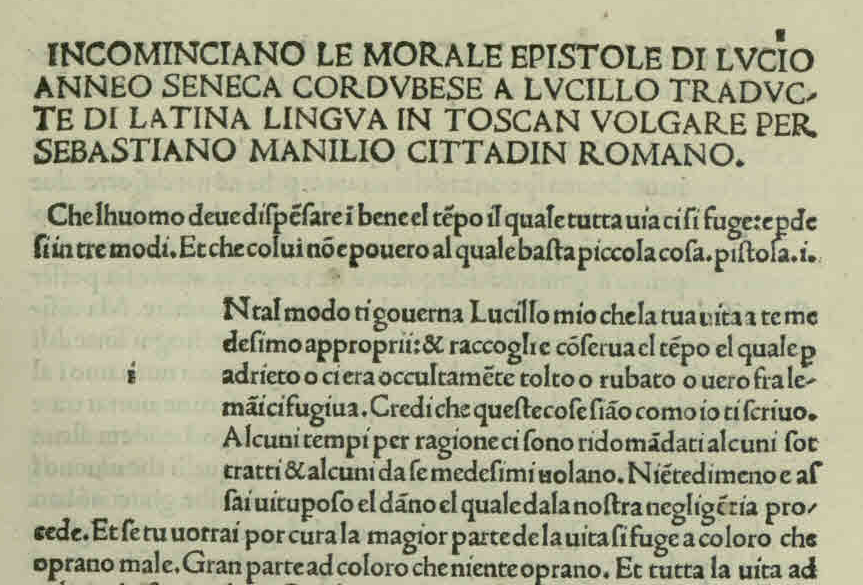
This text is an experiment: a public exchange of letters between Michael Mrak and myself, inspired by Epistulae morales ad Lucilium, in which reflections on sovereignty far beyond the digital context are developed further through dialogue.