
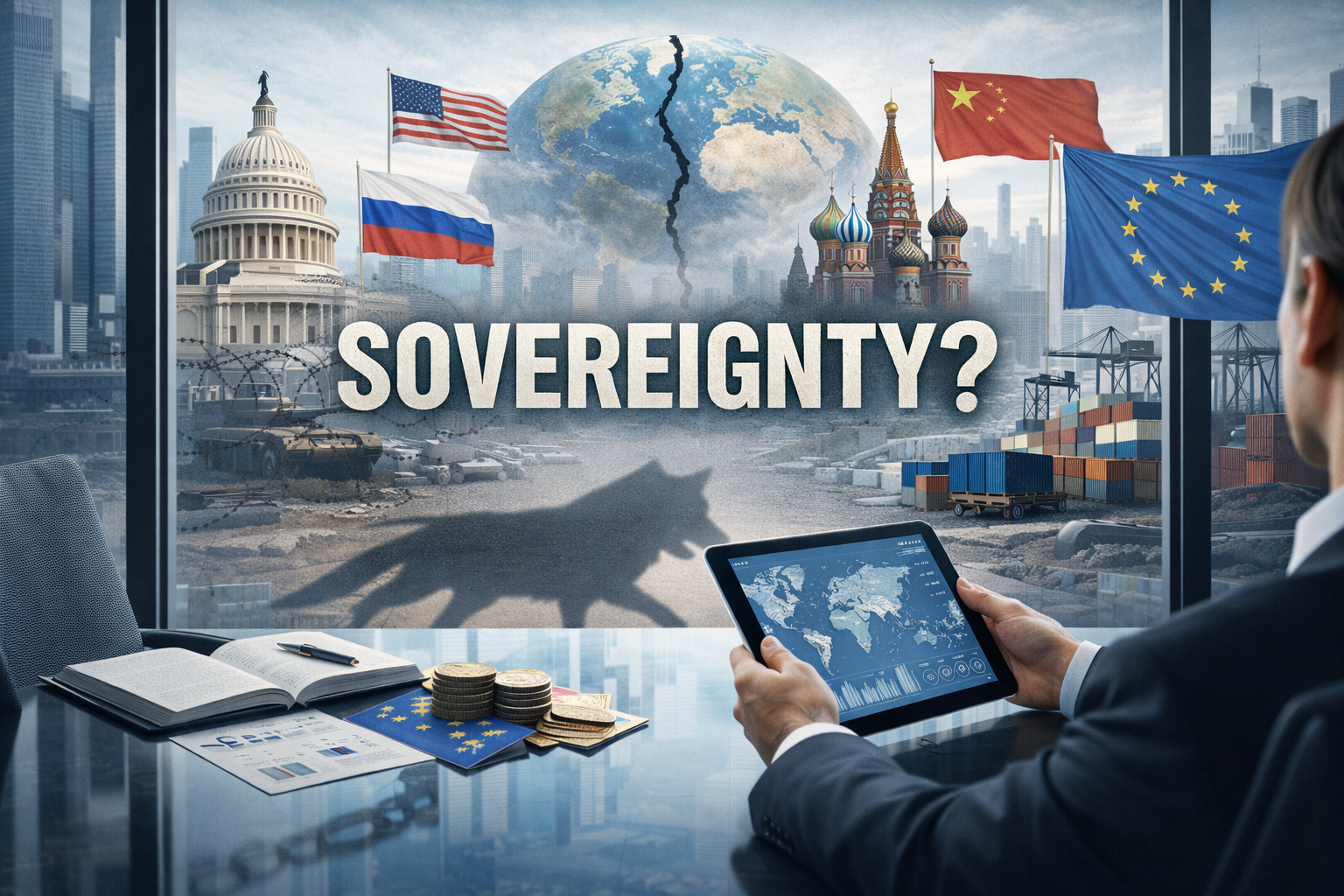
In recent years, global policy shifts by the world’s most influential players have created a powerful momentum for societal change. While public debate often fixates on daily headlines, a quieter and deeper transformation is underway. We are witnessing the rebirth of sovereignty, but not necessarily the empowering kind. One that challenges assumptions many of us grew up with: openness, interdependence, and the quiet belief that globalization, while imperfect, was irreversible.
In today’s geopolitical context, sovereignty has become the wolf in sheep’s clothing. It presents itself as independence and self determination, yet often serves as a gateway to nationalism, fragmentation, and potentially the end of globalization as we have known it.
The New Global Chessboard
The renewed push toward self-reliance and strategic autonomy is driven by four interconnected developments.
The United States has shifted toward a more transactional, protectionist posture. “America First” policies signal a retreat from its long standing role as the primary guarantor of open markets and global free trade. Alliances have become conditional; institutions, negotiable.
Russia’s war against Ukraine shattered a long held European illusion: that economic interdependence would inevitably secure peace. Europe has been forced to relearn a lesson it hoped to have outgrown military power, borders, and spheres of influence still matter. Energy security and defense sovereignty are no longer theoretical debates.
China’s economic statecraft represents a different but equally profound challenge. Through targeted dominance in future-critical industries (green technologies, batteries, rare earths, semiconductors), economic dependency has been transformed into strategic leverage. Trade is no longer just commerce; it is a geopolitical instrument.
The European Union, long optimized as a consumer and export region, now faces an identity crisis. Built for efficiency, scale, and rule-based openness, Europe is struggling to adapt to a world that increasingly rewards power, control, and resilience over cooperation.
Sovereignty and Its Hidden Costs
Sovereignty has returned to political speeches, corporate strategies, and public discourse. Sovereignty sounds reasonable. Reassuring, even. Who would argue against the right to decide for oneself?
Yet the rapid pivot toward renationalization carries substantial risks:
- Economic instability: Fragmented markets raise costs, slow innovation, and replace efficiency with redundancy often without coordination.
- Threats to democracy: Sovereignty narratives are frequently used to weaken multilateral institutions, centralize power, and frame compromise as betrayal.
- Risk of war: As economic interdependence declines, so does its deterrent effect. When countries no longer need each other to prosper, conflict becomes easier to justify.
- Erosion of liberal society: Open societies rely on exchange of goods, ideas, people, and culture. A sovereignty-first mindset narrows that space.
Sovereignty, taken too far, does not strengthen freedom. It constrains it. Neutrality, in many cases, will no longer be maintainable.
What This Means for Businesses: Strategy in an Age of Friction
For businesses, sovereignty is not an abstract political concept, it is a strategic variable.
For three decades, corporate strategy focused on efficiency, scale, and cost optimization. That era is ending. The next one will be defined by resilience, continuity, and political awareness.
This demands a new playbook:
- Frequent strategy reviews: The five year plan is obsolete. Strategy must become a rolling process, reassessed quarterly against geopolitical, regulatory, and supply chain risks.
- Business continuity as a core competency: Sanctions, trade barriers, and political escalation must be treated as seriously as cyber risks or natural disasters.
- From just-in-time to just-in-case: Redundancy and diversification are replacing pure efficiency.
- Portfolio decisions that balance efficiency with resilience, even if that hurts short-term margins.
- Onshoring and friend-shoring: Decisions are increasingly shaped by political trust and alignment, not just labor costs or margins.
- Values clarity: Neutrality is becoming harder to maintain. Companies will be pushed implicitly or explicitly to choose sides.
Large businesses must now act like mini-states. They need to develop their own “foreign policy,” building deep relationships with local governments to ensure their license to operate remains intact as nationalistic sentiments rise.
What This Means for the Individual
The shift toward sovereignty hits the individual in the most personal of places: their wallet, their career, and their freedoms.
The Cost of “Local”
Sovereignty is expensive. Global supply chains kept inflation low for decades. As we move toward nationalized production, individuals should prepare for structurally higher inflation. The “Sovereignty Tax” will be reflected in everything from the price of a smartphone to the cost of heating a home.
The Mobility Squeeze
For the digital nomad and the global professional, the world is shrinking. Work visas are becoming harder to obtain, and “onshoring” means that companies may prioritize hiring within their own borders. Individuals must focus on hyper-specialization, possessing skills so vital that they transcend nationalistic hiring preferences.
Diversification is Personal
Just as businesses must diversify, so must individuals. This includes:
- Financial Diversification: Holding assets across different jurisdictions and currencies to hedge against national economic downturns.
- Skill Resilience: Developing a “sovereign” skillset – talents that are valuable regardless of the local political climate (e.g., tech literacy, energy management, or high level negotiation).
Between Realism and Responsibility
The challenge of the coming years is not to choose between globalization and sovereignty. That choice is false. For businesses and individuals alike, the solution is not to hide from this change, but to build resilience through agility.
However the real task is to redefine sovereignty for a less naïve world. One that preserves openness without dependency, resilience without isolation, and strategic autonomy without abandoning liberal values.
The wolf of sovereignty is already at the door. Whether it protects or destroys what we have built depends entirely on how consciously and how courageously we respond.