

The kinds of crisis a business faces, and how to recognise each one before it is too late
Part of the series Leading Through Turbulence.
The word crisis is used freely these days. But what, by definition, is a crisis? A product recall, a liquidity gap and a slow loss of market all arrive under the same label, and that one word pushes leaders towards one kind of response. The response then misfits the problem.
The first task in a crisis is therefore knowing when you face one. Naming the kind of crisis at hand decides which response fits, and a wrong name wastes the one resource a crisis never returns, which is time.
Three lenses help with that naming. Each lens carries the practical question that follows, namely how that kind of crisis is detected, and how early.
What counts as a crisis
The field offers no single definition of crisis. Three readings have shaped the literature. Charles Hermann, writing in 1963, fixed a crisis by three marks, a threat to the high priority goals of the organisation, a short time for response, and an element of surprise. Christine Pearson and Judith Clair, in 1998, widened the lens to a low probability and high impact event that threatens the viability of the organisation and runs through with ambiguity, in its cause, its effect and its means of resolution. Jonathan Bundy and colleagues, reviewing the field in 2017, shifted the weight again towards perception, treating a crisis as an event that organisation members and stakeholders see as highly significant, unexpected and potentially disruptive, judged as much by how it is read as by what it is.
The three together name the durable core. A crisis threatens something essential, it carries deep uncertainty, it presses on time, and it exceeds the normal capacity of the business. On those four marks the traditions agree.
They part on one point that matters for this article. A definition resting on perception assumes the crisis is noticed, and frequently it goes unnoticed. A business can already sit inside a crisis and fail to register it, because the trouble arrives slowly, or because the people in charge would rather not see it. The smouldering crisis and the wilful blind spot both break the link between the event and its recognition. A crisis does not wait to be perceived before it does its damage, which is why detection, the theme that runs through this article, belongs in the definition rather than after it.
Read as a consequence, this points to the process view set out by Ulrich Krystek and Sebastian Lentz. They treat a crisis less as a single event and more as a process with a beginning and an end, an unplanned and unwanted course that threatens the survival of the company and, left without countermeasures, tends towards its failure. The same view holds the more useful half of the idea, that a crisis also carries the effort to end the condition and to open a path for the development of the organisation. The beginning of that process is the hard part to date, since the onset hides in interpretation, which returns the argument to its centre. The work is to see the process early, while the room to act is still wide.
Three neighbours sit close to all of this and are worth keeping apart from it. A risk is a possible future loss that has not yet materialised, so it is managed by prevention rather than response. An incident or routine problem stays inside the normal capacity of the business and is handled by the standard organisation. A disaster is damage already realised, where the task has moved from steering to recovery. A crisis occupies the ground between these, the point at which the normal organisation no longer suffices and a deliberate decision has to replace routine. Everything that follows assumes that ground.
One word, too many situations
The cost of the single word shows up in the response. Treat a slow strategic decline as an emergency, and the organisation pours its energy into stabilisation while the real problem, an outdated model of the business, moves along untouched. Treat an acute emergency as a strategic question, and the discussion runs on while the building burns. An earlier article in this series separated the two response modes, crisis response and strategic adaptation. This piece steps back one stage and sorts the crises themselves, because the response only makes sense once the type is clear.
Lens one: how fast it arrives
The first distinction is speed. The Institute for Crisis Management has long separated the sudden crisis from the smouldering one. A sudden crisis breaks without warning, in the form of a fire, an accident, the loss of a key person, or a breach made public overnight. A smouldering crisis starts as a small internal problem that is known inside the company and left alone, until it surfaces and the bill arrives with interest.
Most of the damage hides in the second kind. By the Institute’s own counting, roughly three in five business crises smoulder rather than strike. These crises also share an uncomfortable origin, since they tend to grow out of management decisions, or the absence of them. A third shape has become more common in recent years, the creeping crisis, a slow external erosion such as a supply chain that thins season by season or a technology that quietly renders a product obsolete.
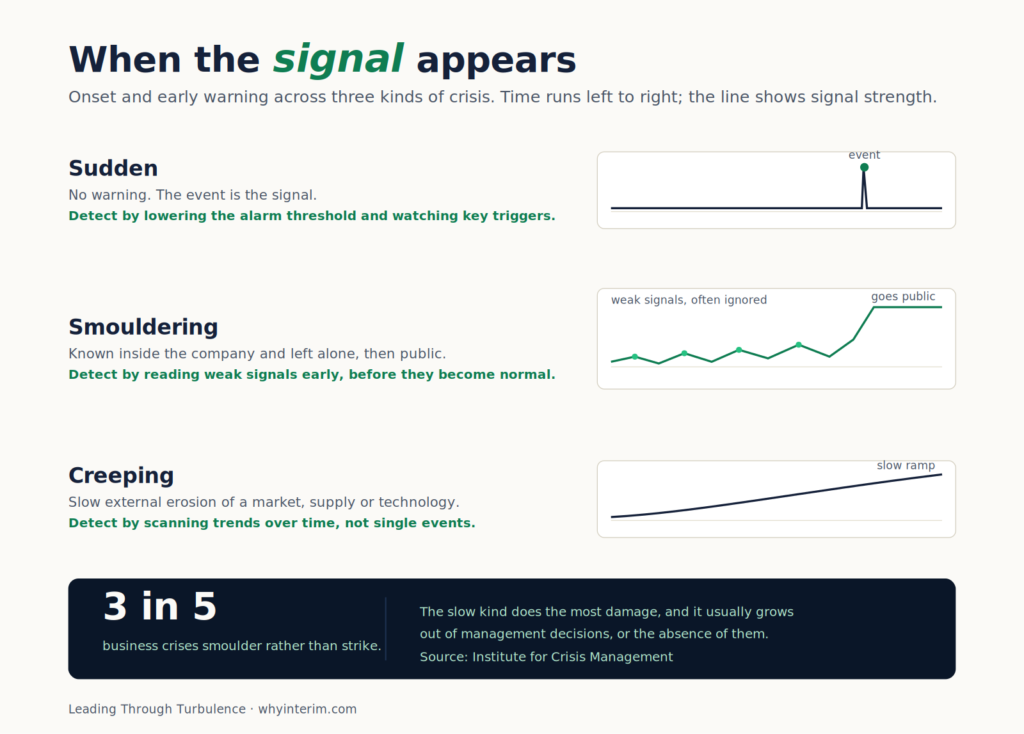
Figure 1. Three patterns of onset, from sudden to smouldering to creeping, and where the warning signal appears in each. Source: Institute for Crisis Management.
Detection follows the speed. A sudden crisis is easy to notice and hard to pre-empt, so the work lies in lowering the threshold for raising the alarm and in watching the few triggers that matter. A smouldering crisis runs the other way. It is hard to notice and easy to prevent, which makes early reading the whole of the task.
Two ideas earn their place here. Igor Ansoff, writing in 1975 on strategic surprise, argued that serious threats announce themselves first as weak signals, faint and easy to dismiss, long before they harden into facts. The discipline he proposed is simple to state and hard to keep, namely to scan the environment for those faint signs and to respond to partial information rather than wait for proof. Ansoff tied this to the decisiveness of management, because a signal seen and not acted upon is no better than a signal missed.
Diane Vaughan explained why the signs go unread. Studying the Challenger launch decision, she described the normalisation of deviance, the slow process by which an unsafe practice that does not immediately cause harm comes to be treated as normal. Each time the deviation passes without consequence, the line of acceptable risk shifts a little further. The warning sat in plain view for years. The organisation had taught itself not to see it.
The contrast in handling is instructive. When cyanide-laced capsules killed seven people near Chicago in 1982, Johnson & Johnson met a sudden crisis of the sharpest kind. James Burke, its chairman, pulled roughly thirty-one million bottles from shelves across the country and absorbed the loss rather than wait for certainty about the scale of the threat. The company read the situation for what it was within hours, and acted on the principle, set out in its Credo, that its first duty ran to the people who used its products. The recall is still studied because the reading and the decision arrived together.
| WHAT THIS MEANS FOR YOU |
| • Match the watch to the speed. For sudden risks, lower the alarm threshold and rehearse the trigger response. For smouldering ones, build the habit of reading weak signals long before they harden. |
| • Treat a recurring small fault as information, not noise. The pattern that keeps passing without consequence is usually the one teaching the organisation to stop seeing it. |
| • Give the quiet problem an owner and a deadline. A known issue with no name and no date is the raw material of the next smouldering crisis. |
Lens two: how far it can be foreseen and shaped
The second lens comes from Stephan Gundel, who in 2005 set out a crisis matrix built on two questions. Can the crisis be predicted, and can it be influenced once it arrives. The pair of questions yields four types.
A conventional crisis can be both predicted and influenced. Industrial accidents and familiar operational failures sit here, and standard contingency plans handle them. An unexpected crisis is hard to predict but manageable once it lands, as a severe storm is for an airline, where the timing surprises but the response is well rehearsed. An intractable crisis can be foreseen and yet barely influenced, because the system itself resists intervention, and Gundel placed events on the scale of a nuclear accident in this corner. A fundamental crisis can be neither predicted nor influenced, the rarest and most dangerous class, into which he placed shocks of the order of a major terrorist attack.
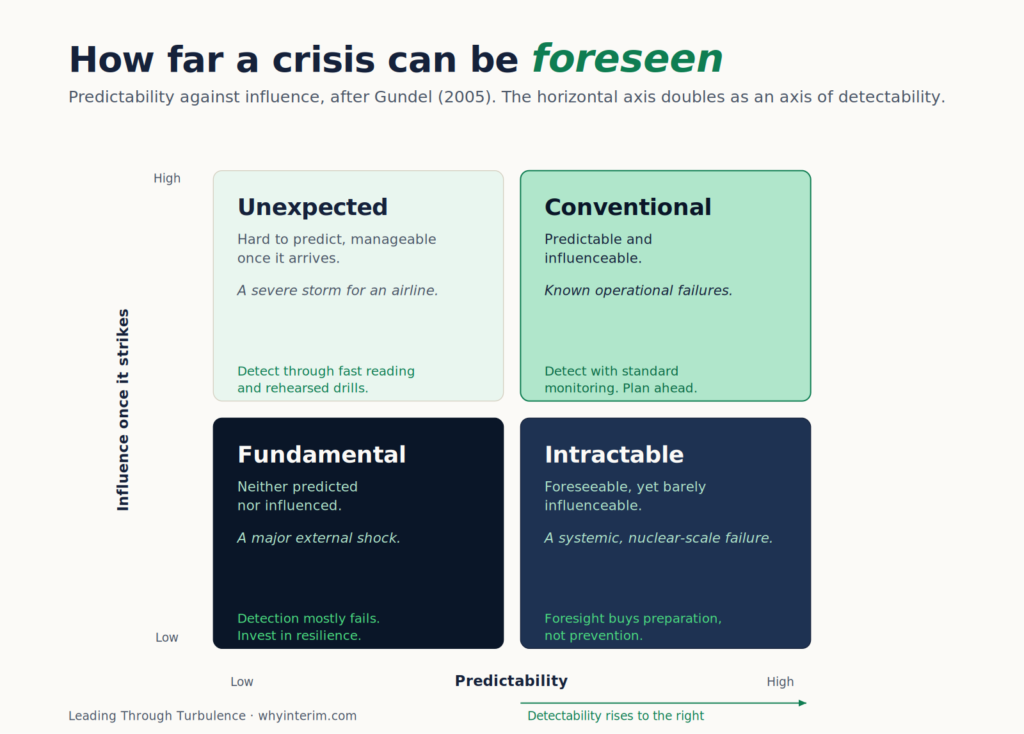
Figure 2. Crises arranged by predictability and influence. The horizontal axis doubles as an axis of detectability. Adapted from Gundel (2005).
The matrix carries a quiet gift for detection. Its horizontal axis, predictability, doubles as an axis of detectability. The further left a crisis sits, the less early warning can do, and the more a business should invest instead in resilience and in reading the situation quickly once the event has landed. Read the other way, the matrix shows a leader where foresight repays the effort and where preparation matters more than prediction.
| WHAT THIS MEANS FOR YOU |
| • Place your likely crises on the two axes before they arrive. The exercise shows where prediction pays and where it will not. |
| • Spend prevention budget on the predictable quadrants and resilience budget on the rest. Trying to forecast a fundamental shock wastes both. |
| • For the foreseeable but barely influenceable crisis, prepare a position rather than a fix. The aim is to stand well when it lands, since stopping it is off the table. |
Lens three: where it comes from
The third lens is the most practical, because it sorts crises by where they begin, and the origin points to the instrument that will catch them. A business faces a short list of domains, and each carries its own sensor and its own cautionary history.
Finance and liquidity announce themselves in cash, where runway, covenants and the conversion cycle warn earlier than the income statement ever will. The collapse of Lehman Brothers in 2008 showed how funding can drain faster than a balance sheet admits.
Operations speak through quality and the near miss, since a rising count of small faults runs ahead of the large one. The Deepwater Horizon disaster of 2010 made that plain, after earlier safety warnings on the rig went unheeded.
Technology and cyber reveal themselves as anomalies, where odd patterns in systems and access appear before any breach becomes public. The Equifax breach of 2017 began with a known and unpatched weakness and ended with the data of nearly 150 million people exposed.
Reputation turns first in the outside voice, in the complaints, the social channels and the press that register a shift in standing before it sets. Gerald Ratner learned this in 1991, when one dismissive remark about his own products stripped much of his company’s value in the months that followed.
The external environment moves on its own clock, and only deliberate scanning of markets, regulation and geopolitics catches the turn. Nokia failed to make that scan after 2007, as the smartphone redrew its market while it held to the handset that had made its name.
People and leadership give the subtlest sign of all, in the quiet exit of the strongest performers and in the silence where candid feedback used to be. Uber found this in 2017, when a former engineer’s account of its culture surfaced what its own internal channels had long suppressed.
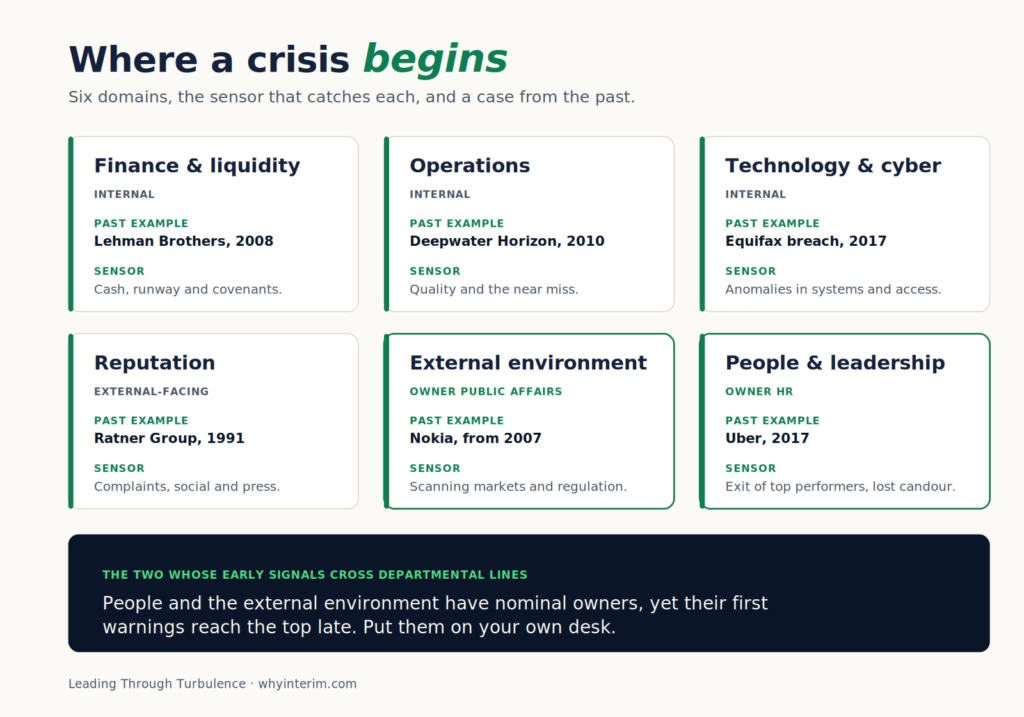
Figure 3. Six domains where a crisis begins, each with the sensor that catches it and a case from the past.
Two of these domains are the easiest to lose. People and leadership may sit with HR, and the external environment with public affairs or compliance, yet the early signal often escapes the very function that owns the domain, because it touches the leadership itself or the logic of the market. A smouldering crisis settles into both with ease.
| WHAT THIS MEANS FOR YOU |
| • Assign every domain a sensor and an owner. A domain that belongs to everyone in theory belongs to no one in practice. |
| • Watch the two domains whose early signals cross departmental lines. People and the external environment have nominal owners, yet their first warnings reach the top late, so put them on your own desk. |
| • Read the exit of a strong performer as a signal, not an inconvenience. The quiet departure often reports a problem the formal channels have buried. |
The discipline of seeing early
Across all three lenses, one pattern holds. The crises that do the most harm are usually the ones a business could have seen and chose, across a hundred small moments, not to. Detection is rarely a problem of technology, because the signals tend to be present. The failure is one of attention, and then of will.
An early-warning system is worth nothing without the readiness to act on a faint signal before it is certain. That readiness is the leadership act this whole piece points towards. Naming the crisis is a decision. Acting on a weak signal is a decision. Refusing to let a known problem settle into normality is a decision. A leader who waits for proof has already chosen, and has usually chosen the costlier path.
Once the type is clear, the response can be matched to it, and the structure of that response is the subject of the next article in this series. A sudden and conventional crisis calls for command and speed. A fundamental or smouldering one calls for distributed attention and early, patient correction. The form of the response follows the type, which is why the type has to come first.
The question that comes before the answer
Three questions help with the naming, one for each lens:
- How fast did the trouble arrive, and is it still arriving? This places it on the spectrum from sudden to smouldering.
- How far could it have been predicted, and how far can it now be shaped? This locates it on Gundel’s matrix.
- Where did it begin, and which sensor in the business should have caught it? This names the domain.
For any leader, a crisis arriving at some point can be taken as given. The useful work lies in answering those three questions early, while the room to act is still wide. The leaders who answer them in good time seldom make the news for it, and that quiet tends to be the surest sign of the work done well.
Further reading
Charles Hermann, “Some Consequences of Crisis Which Limit the Viability of Organizations”, Administrative Science Quarterly, 1963.
Christine Pearson and Judith Clair, “Reframing Crisis Management”, Academy of Management Review, 1998.
Jonathan Bundy, Michael Pfarrer, Cole Short and W. Timothy Coombs, “Crises and Crisis Management: Integration, Interpretation, and Research Development”, Journal of Management, 2017.
Ulrich Krystek and Sebastian Lentz, “Unternehmenskrisen: Beschreibung, Ursachen, Verlauf und Wirkungen”, 2014.
Stephan Gundel, “Towards a New Typology of Crises”, Journal of Contingencies and Crisis Management, 2005.
Igor Ansoff, “Managing Strategic Surprise by Response to Weak Signals”, California Management Review, 1975.
Diane Vaughan, The Challenger Launch Decision: Risky Technology, Culture, and Deviance at NASA, University of Chicago Press, 1996.
Karl Weick and Kathleen Sutcliffe, Managing the Unexpected: Sustained Performance in a Complex World, Jossey-Bass.