
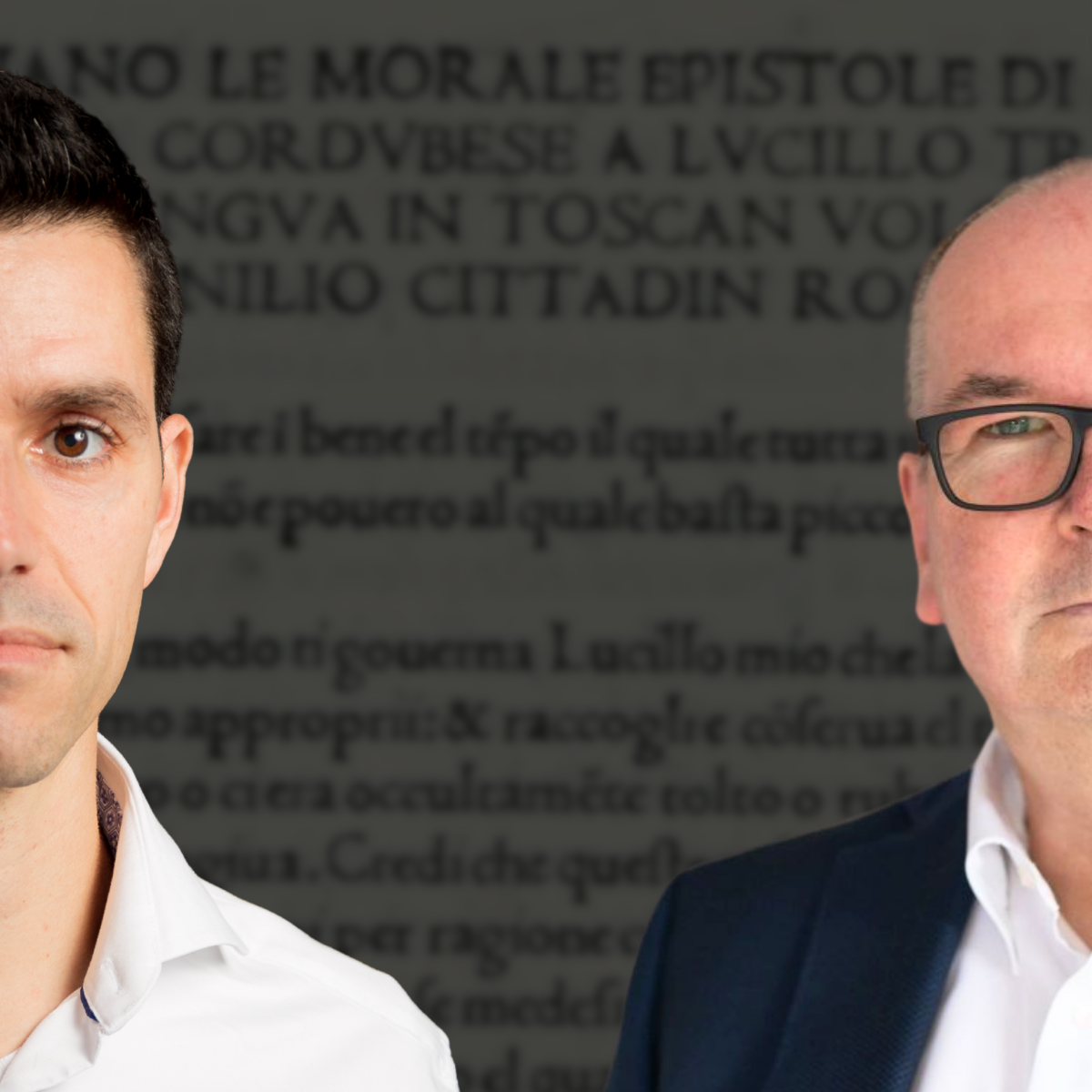
Eleventh letter from Michael Mrak to Andreas Bruckmüller
My dear friend Andreas,
Your tenth letter performed a turn for which I am grateful. In my ninth letter I had stopped at the diagnosis. You took the diagnosis and translated it into a movement: not despair, but acceleration. Not conviction as a precondition, but arithmetic as a lever. It is the soberest form of hope I have read in a long time, and it convinced me.
But it leaves one question open that I have been chewing on for a long time. It is the question readers ask me after each of our letters, and it is the question I ask myself most often when I leave a consulting appointment that did not go well.
What do we do with those who do not want to come along? With the eternal naysayers, with the deniers, with those exhausted by doom?
You say the majority wants this transition to succeed. I believe you. But the loud minority that wants precisely the opposite is once again setting the pace for the majority. It sits on supervisory boards, it writes leading articles, it organises election campaigns, it fills comment sections. And it cannot be persuaded by argument, because the denial does not come from a shortage of arguments.
This is the point at which I want to start differently than before. I do not want to talk about those who should be won over. I want to talk about us, about those who lead, advise, decide, write. About the discipline we must develop when we speak with people whose first, second and third answer is no.
Anyone moving in our professional environment learns early to distinguish two kinds of denial, even if they sound identical at first hearing.
The first is ideological denial. It cannot be reached with facts, because it is not built from facts. It is an identity. Whoever, in the year 2026, still disputes human-made climate change in principle does so not because data are lacking. He does so because his belonging to a political, social or professional group depends on disputing it. To argue here with studies is to reinforce the identity rather than to shake it. This is the psychology of counter-mobilisation, and it has been documented for decades.
The second is exhausted denial. It looks similar on the surface but is something else entirely. It comes from people who have listened, who know what the situation is, and who therefore no longer want to listen. It is not an identity but a shield. Behind it lies not the belief that the problem does not exist, but the worry that it is too big to do anything about.
Ideological denial is a wall. Exhausted denial is a door that has fallen shut because it stood open too long.
Both call for different answers. Anyone who confuses them fails at both.
Over the past years I have had many conversations that ended in the same dead end. I came with numbers, my counterpart came with other numbers, in the end we were both annoyed, and no one had moved their position. Climate communication research has described the pattern for years. Per Espen Stoknes has called it the psychological climate paradox: the more facts we put on the table, the stronger the defensiveness of those who feel threatened by the facts.
What does work, first, is not to proselytise. Anyone who enters a conversation with the goal of converting the other side will get nowhere. Anyone who enters with the goal of actually understanding the other side’s reasons, sometimes a great deal.
What works, second, is to find the common ground that is not under dispute. A farmer who rejects the term climate change will readily tell you how unpredictable the weather has become, how the soils are changing, how he has to shift his planting calendar. A homeowner who rails against the energy transition knows his heating bill in detail. A managing director who curses the Green Deal as a bureaucratic monster nonetheless has a very clear picture of what insurance premiums for extreme-weather damage do to his balance sheet. These are entrances, not battlegrounds.
What works, third, is that the solution comes before the problem. Anyone who opens with the catastrophe closes doors. Anyone who opens with the solution and only then says which problem it solves, opens them. This is an old sales principle, and it works no differently in political communication than in commercial.
What works, fourth, is to show social models. People rarely change their behaviour because they were convinced. They change it because other people, similar to them, have led the way. The neighbour with a heat pump carries more weight than any study. The competitor who has electrified and is saving money carries more weight than any whitepaper.
And what works, fifth, is to change the language. Not every debate has to be conducted as a climate debate. Energy independence, safeguarding the site, resilience, insurability, intergenerational responsibility, all of these are terms that lead to outcomes we want without leading us into the trenches in which we are stuck. You demonstrated it in your tenth letter when you framed the energy transition as a hedging argument. It is the same thing in a language that forces no one into defending an identity.
Some truths land better when they appear not as truth, but as a good idea.
This is not pandering. It is the recognition that language creates conditions. Anyone who does not command it gives away half the effect of what he says.
The other group is closer to me, and hurts me more, because I understand it better. These are the ones who do not sleep at night, because they know the numbers. Who can no longer give their children an honest answer when asked about the future. Who oscillate between grief, anger and paralysis. Research calls this climate anxiety, and it is no longer a fringe phenomenon. The major surveys of recent years show that a considerable share of young people know it, and that the burden is greatest where the feeling of not being able to do anything dominates.
Here the task is a different one. It is not about convincing someone. It is about giving back the capacity to act.
Environmental psychology distinguishes, rather helpfully, three ways of handling such strain.
- Problem-focused: What can I concretely change, within my sphere of influence, with my means?
- Emotion-focused: How do I regulate what I feel when I read the news?
- Meaning-focused: How do I reinterpret my role in what is happening?
Anyone who wants to stand by people caught in future-anxiety should open all three doors, not only one. Speaking only about action to someone who is emotionally spent comes across as cynical. Speaking only about feelings to someone who wants to act comes across as patronising. And the most important of the three doors, the meaning-focused one, is the one most often forgotten.
It opens with a simple shift: from victim of circumstance to co-author under circumstances. No one can halt climate change alone. But everyone can decide in what role they wish to face it. And that decision is not small. It changes how a person walks through the day, which conversations they have, which decisions they make, which post they accept, which assignments they decline.
In your eighth letter you said: These four qualities can be practised. Not perfected. I believe the same holds here. No one escapes future-anxiety once and for all. But everyone can practise not letting it become the leading voice.
So that this letter does not remain in theory, I will tell you what I do concretely. Not because my practice is the only right one, but because it has kept me from landing in both camps at once, the cynical and the resigned.
- The first practice is the question before the answer. When someone in front of me relativises climate change, I do not answer with facts. I ask. What would change for you if what the research says were true? What would you then have to think about differently? What of that would hit you the hardest? These questions do not hurt, because they assume nothing. But they open something that remains closed in the pure factual debate: the worry behind the denial. Sometimes it is the worry about the job. Sometimes about identity. Sometimes about the feeling of having been in the right. As long as this worry is not spoken, nothing moves. Once it is spoken, you have a ground on which to go further.
- The second practice is the small appointment instead of the great conversion. I try to leave every conversation with one action that holds for both sides. Not: Let us save the world together. But: Let us look at the heating data of your office building next month. Let us check what a PV system on your roof costs. Let us run the numbers on your vehicle fleet properly. Such small appointments produce facts. Great declarations produce arguments.
- The third practice is the self-imposed duty of the news of success. I have made it a habit to take note of at least one report of substance each day in which something has worked. Not out of whitewashing. But because our media environment is built to filter precisely this out. Bad news sells better, and our brain is evolutionarily set to weight it more heavily than good. Anyone who sets nothing against it inevitably lands in the impression that everything is getting worse, even where it is demonstrably getting better. That would be, as you said in the tenth letter, not realism. It would be the confusion of the loud with the true.
Anyone who does not impose this hygiene on themselves is exhausted after three months. Anyone who does impose it lasts even into the eleventh year.
Optimism is not a mood. It is a hygiene of the gaze.
Let me add something that may sound contradictory to all that has gone before. As patient as we must be with the exhausted naysayers, we should be that uncompromising towards professional, organised, financed denial. What we must not give it is the false balance.
There is still a reflex in newsrooms, on panels and on supervisory boards to confront every statement about the climate crisis with a counter-statement, as if the question of whether the earth is warming were a matter of taste. It is not. It is physics. Whoever, in discussions with a scientific foundation, sets an unfounded counter-voice next to every founded voice creates an artificial stalemate that does not correspond to the truth. This very stalemate is the rhetorical staple of organised denial. We should stop supplying it.
That does not mean dissenting voices are not given the floor. It means insisting that the word they speak meets at least the same standard of evidence as the word they contradict. In the fifth letter you described division as the method of those who profit from breakdown. The false balance is one of their most important tools. It consumes our energy in endless debates about settled matters and keeps us from clarifying the open questions we should actually be answering together.
Tolerance towards persons is a virtue. Tolerance towards empty assertion is not.
This, I believe, is the finest line in the whole matter. Patience with the persons, rigour with the method.
As I write this, I hear the objection that comes next. Fine, but the world is burning, and we are talking about conversation technique. I understand the objection, and I have made it often enough myself. But it falls short.
Every structural change I have observed in my career has two layers: a technical one and a cultural one. The technical is usually faster. The cultural is usually decisive. Anyone who tackles only the technical layer builds solutions no one wants. Anyone who tackles only the cultural talks themselves into a corner without anything happening. The acceleration you described in your tenth letter is the technical half. What I am trying to describe here is the cultural. Both need each other.
And both need people who are practised in both. Who know how a heat pump in an existing building becomes economical, and who know how to handle the owner who has spent ten years explaining that it will never work. Who can read an annual report and hold a conversation at the kitchen table. Who can persuade a supervisory board and listen to a neighbour. This double gift is rare, and it is exactly what the coming years will need.
You closed your letter with Let us get to work. I close with a slim addition: Let us also get to work with those who are not yet convinced, and with those who once were and cannot bear it any longer. Both are part of the majority you spoke of. Only that the first must still find their way to us, and the second must find their way back.
The energy transition is a technical task. The societal transition that carries it is a linguistic one, a psychological one, an interpersonal one. It demands of us to be more patient than we believe we can afford, and more uncompromising than is comfortable to us. Both at once.
This is the discipline I commend to you, to myself, and to all who read along. It is not naive. It is the only one I know in which we do not lose the next twenty years.
Michael
This text is an experiment: a public exchange of letters between Michael Mrak and myself, inspired by Epistulae morales ad Lucilium, in which reflections on sovereignty far beyond the digital context are developed further through dialogue.